COUNTY WEXFORD - Dunbrody Famine Ship, exploring Irish emmigration history

In the lead up to our trip, I did some research into my family lineage. I have been told that my ancestry was made up of English and Irish heritage, but I was interested to know specifics before coming to Ireland. So I signed up to Ancestory.com.au and did some hunting around. 

If you haven’t ever used ancestory.com.au before, I’d highly recommend it. It was so intriguing to be able to trace all the generations back until around the end of the 1700’s. Ancestory.com.au draws on data from Australian Births Deaths and Marriages, as well as immigration data and gravestone registries. It’s also able to tap into English and Irish census and baptism data. All you need to provide to get started is the full names and rough years of birth of your grandparents, and then Ancestory.com.au will start to populate all your great grandparents through out the previous generations. (I’m also just trusting the accuracy of ancestry.com.au at this point, I haven’t gone any deeper and crosschecked any other data at this point.)

I had to go back sometimes 5 or 6 generations until I found a grandparent that emigrated from Ireland to Australia. I even discovered at lest three great (x4 ) grandfathers who were convicts! (I’m not sure if that’s really something to be proud of and I’m sure most Australians can make this claim)  But many of my Irish ancestors left in the mid 1800’s around the time of the Great Hunger, which brings me to the topic of this blog post, our visit to the Dunbrody Famine Ship in New Ross. 
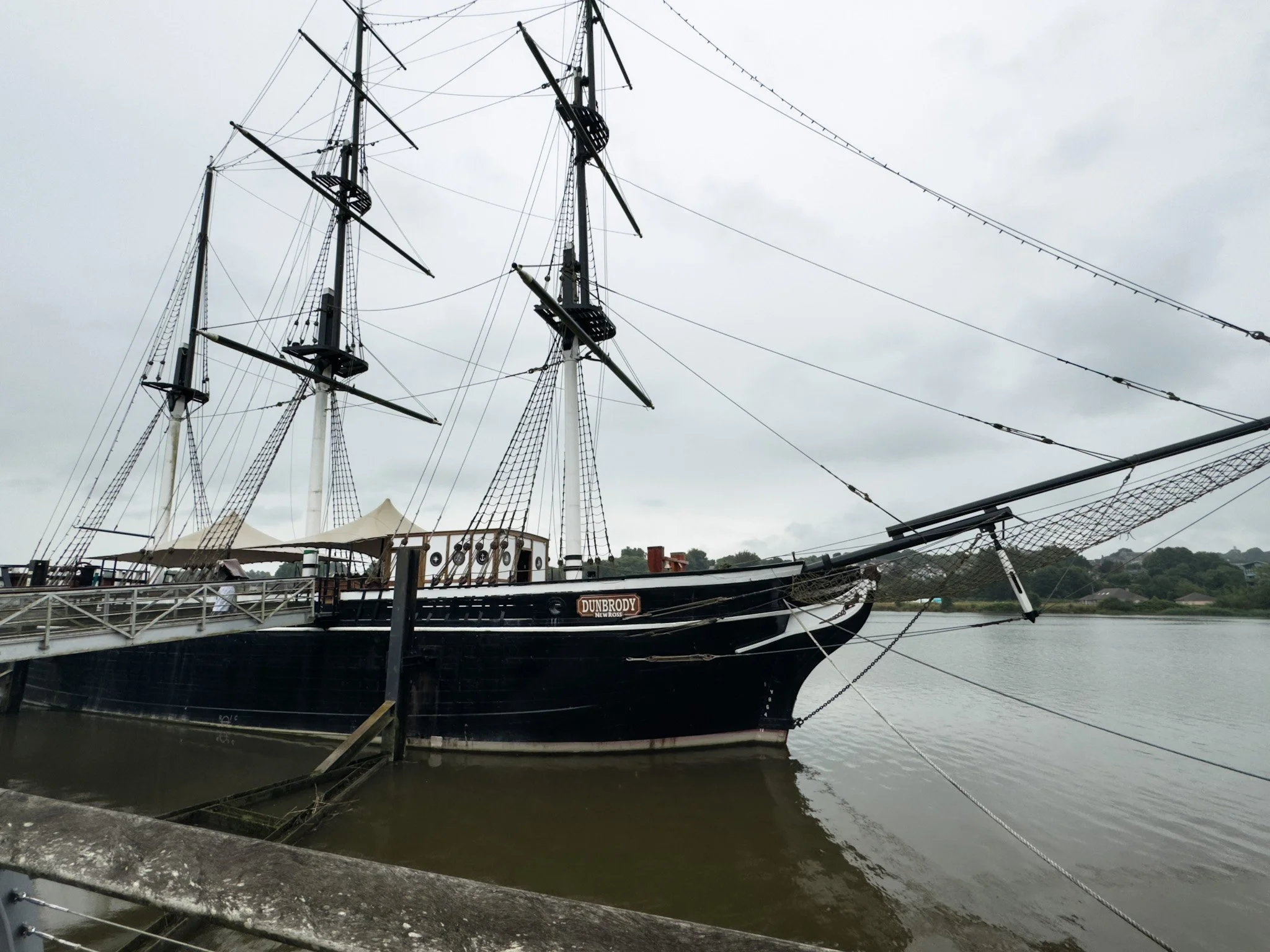
The Dunbrody that sits in the harbour of New Ross is a 1:1 replica of the actual Dunbrody, a merchant ship that was converted into a passenger ship and transported Irish emigrants to North America during the 19th Century. Many Irish people chose to, or were perhaps given no choice but to, emigrate to ‘the new world’ at this time because they faced such hardship and injustice.

Irish history is incredibly complex and marred with much conflict and turmoil. While I’ve been here in Ireland, I’ve been able to learn about Irish history from the Irish perspective, rather than the British perspective that many Australian would have been taught, so I will try my best to honour the experience of the Irish while retelling it. 

During the 19th Century, Ireland was under the oppression of British who had sort to incorporate Ireland into the British Empire. The Irish fought against this from 1919 - 1921 during the Irish War of Independence but afterward the English still took over vast quantities of land and forced the native Irish to pay rent for small farming plots. 

The Irish farmers relied heavily on potatoes as their main source of food, however, year after year from 1845 - 1849, a blight infected all the potato crops, leading to poverty, evictions and starvation for the poor class of Irish farmers. However during this time, Ireland was still exporting a surplus of food (meats, grains etc ) to Britain. So it does pose the question as to weather it this period of history can be referred to as a famine or something more deliberate or sinister like a genocide. Or perhaps the British just saw it as an opportunity to discriminate against and weaken the native Irish population. Th result was that over a 1 million people died of starvation or disease and another million emigrated to the USA, Canada or Australia. Nowadays, the term The Great Hunger seems like a more appropriate way to describe this period of history.

 I was able to trace my ancestors to areas of County Carlow (like the towns of Borris and Tullow, not far from where we were staying ) and County Wexford. (The town of New Ross were the Dunbrody is locations in on the boarder of County Wexford and County Carlow.) as well as County Wicklow, Tipperary, Cork and Galway, Antrim and Armagh. Whilst The Dunbrody focuses on the journey to the America’s, not Australia, it does provide a bit of insight into what the conditions of anyone emigrated from Ireland around that time would have had to endure. The journey to Australia was much longer, with probably more treacherous  seas. 

The Dunbrody experiences take you on a journey of what it would have been like for passengers embarking on a passage to Savannah, Georgia in the USA. It starts with a video detailing the conditions Irish people were facing and what lead them to take their chances on ships like the Dunbrody, which were often referred to as ‘coffin ships’. 

After the video, we were lead onto the ship and given a tour above and below deck. The guide spoke as if we are actually ‘steerage’ the lower class passengers, showing us our sleeping quarters and informing us about our rations and allocated time above deck each day (which was only 30 minutes). Two other guides acted in character of some of the other ‘passengers’ who were onboard. One girl played the part of a mother who had 5 children onboard and who’s husband tragically didn’t make it off the ship alive. 

The conditions passenger had to endure for the 6 - 9 week journey over to North America was so heart wrenching and disgusting! I can not even begin to imagine what it would the been like to live below deck on biscuit rations, surrounded by other people, no showers, no toilets other than a communal pot. In the photos above you can see the bunks below deck, there would have been 4 adults per square ‘cubicle’ 

It was a very eye opening experience. I can only assume that my Irish ancestors were on a similar ship in order to come to Australia. It’s very confronting to think about. 

After the tour on the ship finished, were are able to explore it on our own before leaving through the final exhibition that details some of the more famous Americans that have Irish ancestry, most notably, the Kennedy family. The Kennedy family actually have a historic homestead / museum not from New Ross and were a part of the project to create the Dunbrody Famine Ship Experience. I was tempted to go to the Kennedy Homestead but I knew it would of been zero interest to the kids. The cafe in New Ross that we had breakfast in had all sorts of historic photos of JFK and the Kennedy Family. 

Overall, the girls and Braino really enjoyed visiting The Dunbrody. Hallie especially has enjoyed drawing pictures and creating her own stories about the Dunbrody. She asked to find a book about the Dunbrody at the library but all I could find was one about a family’s experience during the Great Hunge; having to go to a workhouse after getting evicted, which was equally as interesting. Braino and I have enjoyed piecing together our knowledge of Irish history and politics through museums and experience like The Dunbrody, and I think it was a great way for the girls to gain a bit of an understanding into Australia’s history and our own family history. 

COUNTY TIPPERARY - Cahir Castle, Ireland's Best Preserved Thirteenth Century Stronghold

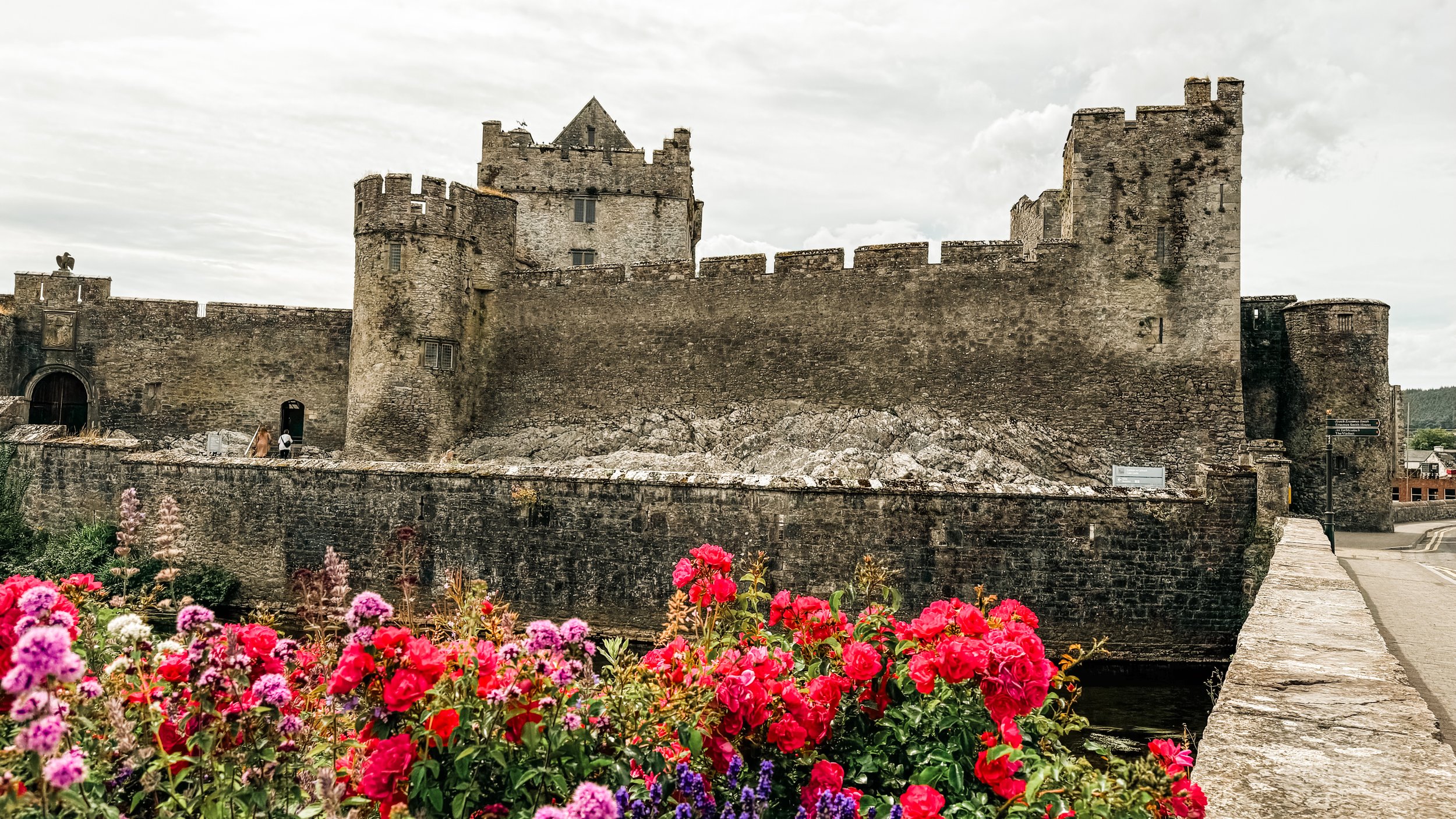
Cahir Castle is located in the town of Cahir, along the River Suir. It’s one of Ireland largest and best preserved castles and has been used in many film and TV productions like Excalibur and The Tudors.

As I mentioned earlier, we decided to skip Blarney Castle while in Cork and visit Cahir Castle on the way home instead. It’s surprisingly overlooked, which means it’s less touristy and has cheaper admission prices. (Children under 12 are free)

We were able to have lunch at a cafe right across the road and we didn’t need to book tickets in advance.

The girls really enjoyed climbing up many of the narrow stone spiral stairways and taking in the view out over the river and town below. They particularly like the model of the castle (photograph below), which has an interactive light-up scene that depicted the timeline of events leading up to the castle being captured by Devereux, Earl of Essex, in 1599. Cahir Castle was the powerful stronghold of the Butler Family and was considered impenetrable, however this during this siege it had been battered for three days - the first time heavy artillery was used against it.

I would recommend Cahir Castle to anyone who is also making a stop at The Rock of Cashel, 2. - 3 hours is more than enough time to join the free tour, watch the audiovisual show about the castles history and wander through all the rooms. Plus it’s located in the centre of town which makes it great for a lunch stop, with parking very close by.

COUNTY TIPPERARY - Exploring The Subterranean Wonders of Mitchelstown Caves

On the way back from Cork, we stopped off at two different destinations; the Mitchelstown Caves and Cahir Castle. The two are quite close together and also quite close to The Rock of Cashel, you could do all three in a day of you really wanted to. But this post is just about the Mitchelstown Caves.

I really love visting caves, there is something so fascinating about them. Last year in September, we visited the Wellington Caves near Dubbo in New South Wales, with my extended family - it was such a good trip with all the cousins. The Wellington caves were the highlight of the trip for me. I think I also remember visiting a cave when I was really young while staying with relatives who lived near Ashford in Country New South Wales. But anyway, Ireland has a number of ‘showcaves’ as they call them, so we decided to stop off and see the Mitchelstown Caves on the way back.

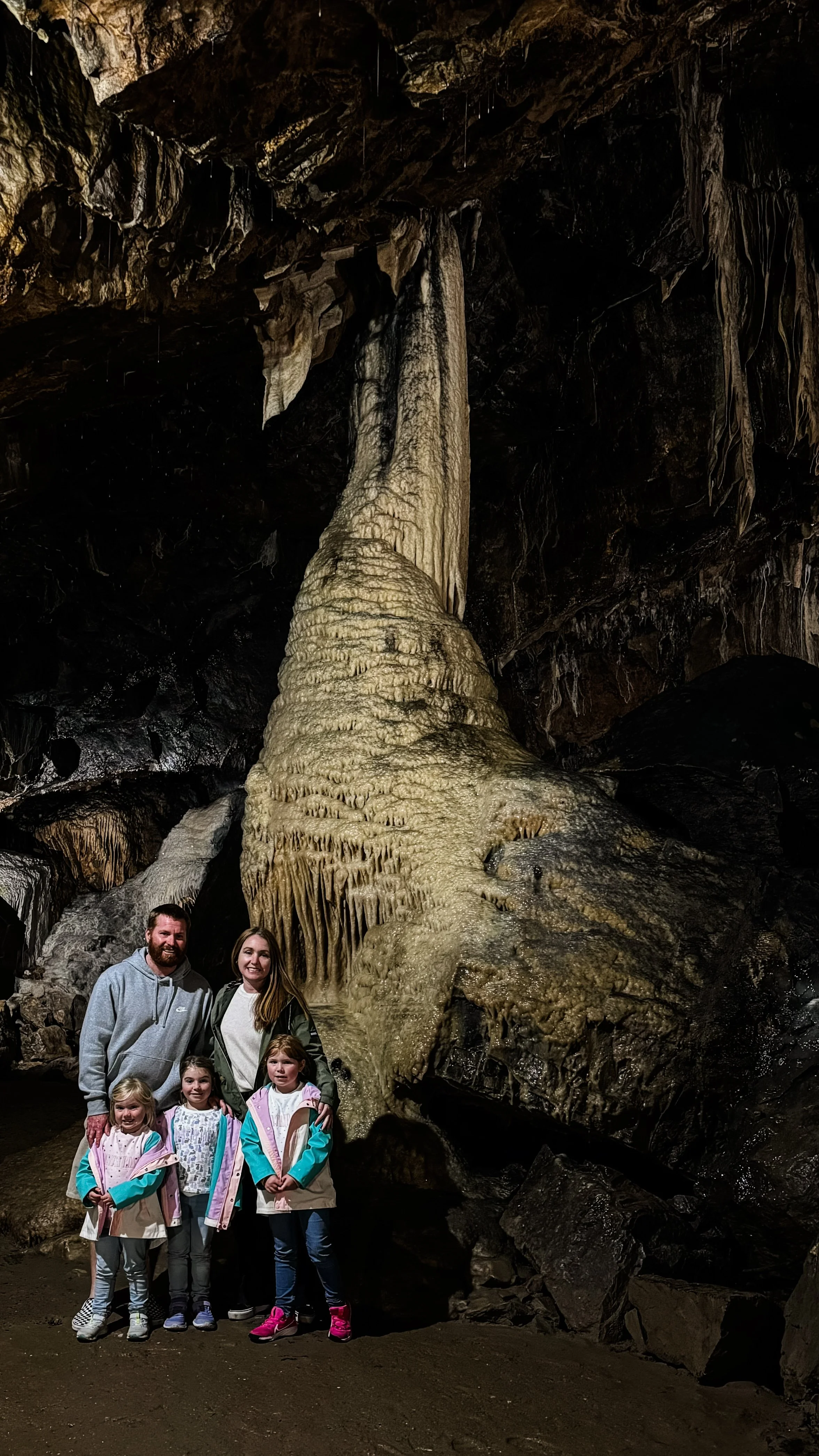
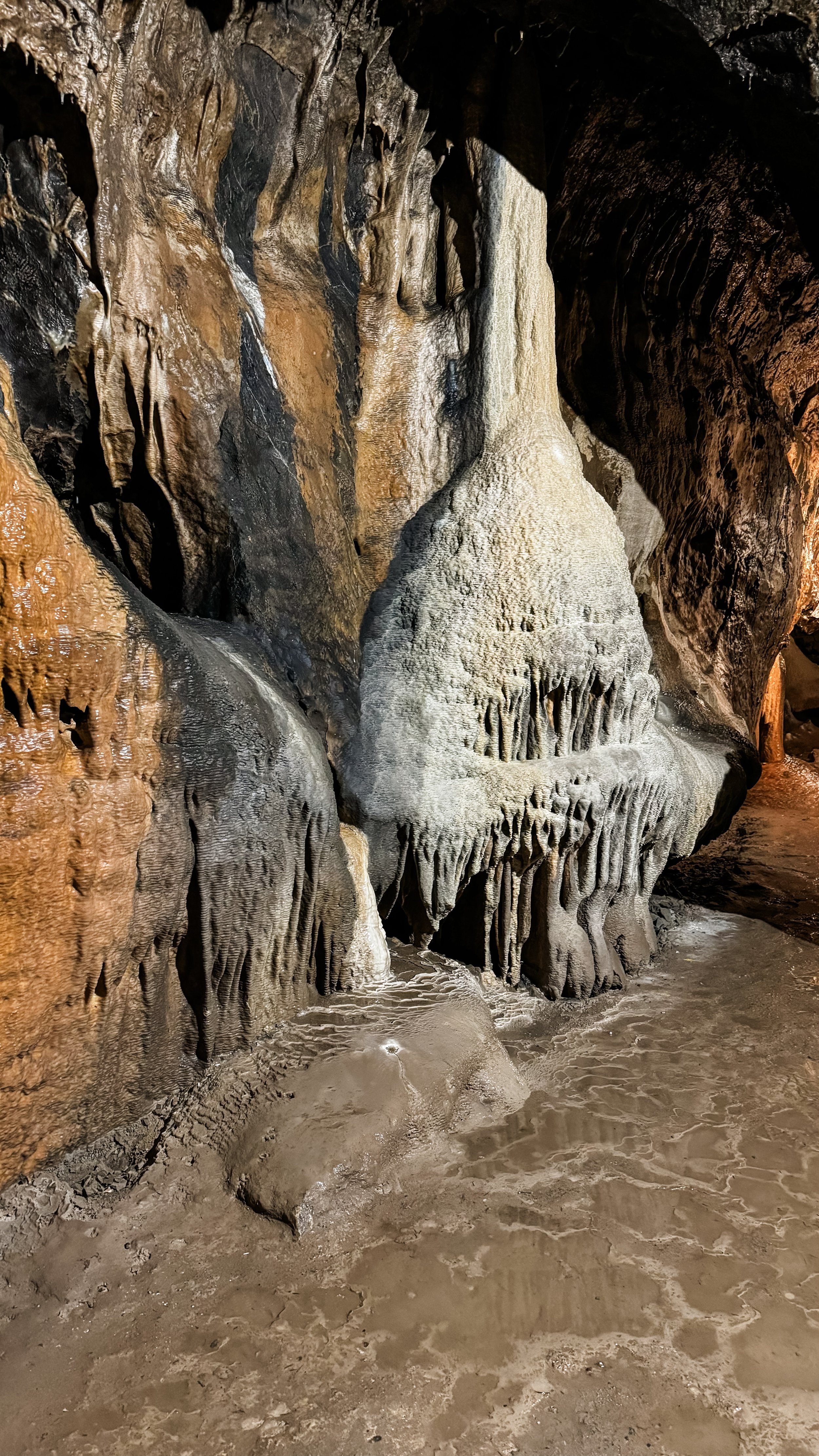
The caves were discovered by a local farmer, Michael Condon in 1833. He found them when his crowbar fell down though a crack in the ground. The land that the caves are on have been owned by the same family ever since, and the original farm house still serves as the admin / ticket building. There isn’t any indication that the caves were used by humans throughout history, there hasn’t even been any animal fossils found in the limestone cave systems.

On arrival we entered through the hole pictured below and descended down some very steep steps that were construction with concrete in the 1970’s. We were in a decent sized group of about 12 people with two young ladies as our guides. They provided some fascinating facts about the caves as they led us through three large caverns. The sheer scale of the caves is simply breathtaking, it’s such an otherwordly feeling being deep below the surface of the earth and I always think of how intrepid the people who first explored the cave were, venturing deep into the unknown

At one point, the guides turned all the lights off to demonstrate how dark the caves really were and my gosh, it was pitch black! It was a very unsettling sensation but the girls were really brave. Electricity was run down in to the cave systems in the 1970’s, before that the explorers and visitors used candlelight and torches.

In recent years, the caves have been used for events, concerts, film premieres and as film locations. Visiting the caves was such a great experience for the girls, it challenges them a bit in terms of getting out of their comfort zone and building self confidence. They were so brave, having already experience what caves are like in Australia and so well behaved in terms of listening to the guides . It also gives them a bit of an intro into geology and earth science. I’d highly recommend a visit to a cave as a learning experience for kids.

If you are planning to visit the Mitchelstown Caves, do call ahead and make a booking. We called on the morning of our visit and had no trouble booking into one of the time slots that day. They have guided tours every hour or so between 10am - 4pm. From memory - the tickets were about 8 euro each.

COUNTY CORK - Kinsale, A Vibrant Seaside Village

On the way back to Cork from Clonakilty, after driving through stunning countryside and harbours, we stopped off in the small seaside town of Kinsale. Kinsale is set in a picturesque harbour itself and has become known for its colourful streets, vibrant culinary scene and rich history, which includes pirates! Whilst I was researching our trip, I listened to many podcasts from Rick Steves and I remember him mentioning multiple times how lovely Kinsale was, and it certainly lived up to the hype!

We stopped off for only a short wander around but we arrived to lovely blue skies and a warm afternoon. We found a playground along the waterfront to play in, then wandered further into the main streets where we enjoyed an icecream (the girls) and pint of Guinness ( Braino ) and a browse around the boutique shops (myself). And of course, we stopped off in a quaint little bookshop. Playgrounds, icreceams and bookshops are our winning combination to keep the girls happy. Although we have be fortunately enough to be able to sign up to the libraries here in Ireland and we’ve been borrowing plenty of books, which saves us having to negotiated the purchase of books at all the bookshops we pop in to.

If we had more time in Kinsale, I would have like to check out Charles Fort, which is the large star shaped ruins of a military fort that stands on the headland and overlooks the harbour. It was pretty fascinating to see the miniature version of it at the Model Rail Village, so it would have been cool to wander around the real site.

COUNTY CORK - West Cork Model Railway, Handcrafted History and Miniature Trains

We travelled down to Cork for two nights, to see more of the south coast of Ireland. After visiting The Rock of Cashel on the way, we stayed at Maldron Hotel in Cork City. It was a fantastic hotel; the room had three single beds and a double for Braino and I. It was a really spacious room with a nice modern bathroom. The hotel also had an indoor pool, which is such a hit with the girls. They really love swimming and are very confident in the water. We’ve had lots of comments from people saying how good at swimming they are. We have to explain that we are actually from Australia, and swimming is a huge part of our culture. In Ireland, many kids older than Farley are still using flotation devices. Swimming just isn’t as high a priority in Ireland as it is in Australia.

On the first afternoon that we arrived, we headed out to explore Cork City as the hotel was within walking distance. However, we were left a little disappointed. It was rainy and coldish and it was a Sunday evening, so I don’t think we really went at the optimal time, but it didn’t have the same sort of vibe as Dublin. It was a bit bleak with some questionable characters. So we decided to look further a field for things to do on the following day. However, one thing in the city that would been good was the Blackrock Castle Observatory which is a planetarium in an old castle, but it unfortunately wasn’t open on the days that we were there. Farley would have loved it.

Many people come to Cork for Blarney Castle, which is only about 20 minutes out of town. It’s one of the most iconic tourist sights in Ireland and it’s famous for the Blarney Stone, which you can lay on your back, lean over the edge of the castle, and kiss. It’s also known as the ‘Stone of Eloquence’ and is meant to give you the ‘gift of the gab’. I’ve actually kissed it already when I visited Ireland for 2 days back when I was 19 and Braino wasn’t at all keen to kiss the stone - he’s already got the ability to strike up a conversation with anyone, haha! So we decided to give the Blarney Castle a miss. In terms of prices, it’s one of the more expensive castles to visit. I remember the gardens around the castle being lovely, but in terms of value for money and avoiding crowds, it didn’t seem like a good choice.

One thing we did decide to do, which we knew would be great value for money for the kids, was the West Cork Model Railway Village in Clonakilty.

The West Cork Railway Village contains miniature versions of four different West Cork towns, Kinsale, Clonakilty, Bandon and Dunmanway, based on how they were in the 1940’s when the towns were served by the West Cork Railway.

All the miniature buildings and tiny people have been lovingly handcrafted by local tradesmen, while there are miniature trains that connect each town. The Model Village was opened in 1994 and has proved to be a great, family friendly way to learn about the history of the area, in particular the West Cork Railway which was in operation from 1886 to 1961. The level of detail was incredible! I really appreciate the time, effort and skill that would gone into creating the buildings, all based on real locations. The tiny people and little scenes throughout the towns were extra impressive.

The kids absolutely loved the place, in particular Hallie, who has always had a fascination with trains. But Farley has also developed an appreciation for miniature models of towns and landscapes. The girls also loved steering the remote control boats and having a go of the mini diggers. Although our one gripe would be that you needed extra coins for the boats and the diggers; the website gave us the impression that they were all included in the admission prices.

But what was also included in the admission price was a little train ride into town and back. The train was a novelty train with wheels that could go on the public roads. We also saw a similar one in Kilkenny, designed to give tourists an overall view of the main streets. The girls love it, and Braino and I made the most of being the daggy tourist parents that wave to all the locals in the town.

Afterwards, we headed into the town and had lunch (although there was a cafe onsite at the Model Rail Village and it was picnic friendly too). I really liked the town of Clonakilty, it was very colourful and tidy and had a really nice medium size vibe to it. I’d probably recommended staying here or Kinsale, which is where we headed next…..

COUNTY TIPPERARY - The Rock of Cashel, Where Legends and History Converge

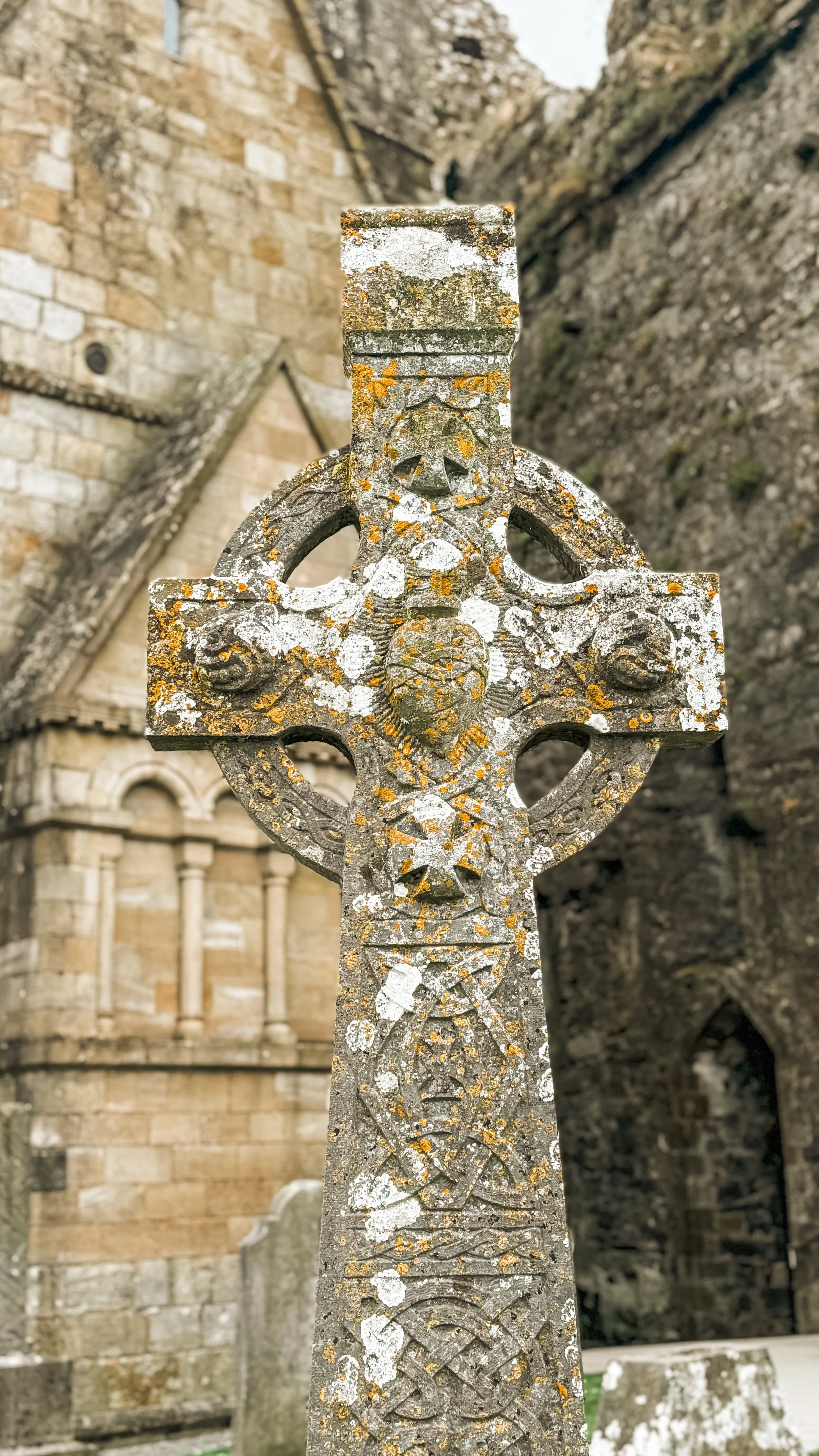
The Rock of Cashel is truly a magical sight. Perched high on a rocky limestone hill, it looms over the town of Cashel and is steeped in the legends and history of ancient Ireland. Also known as St Patrick’s Rock, it is said to be the place where St. Patrick converted the King of Munster to Christianity in the 5th century. The site features a collection of remarkable buildings, including a round tower, a high cross, Cormac's Chapel, and the imposing cathedral.

We visited The Rock of Cashel on our way down to stay in Cork for 2 nights. It’s set on the edge of the small town of Cashel and it is popular with tour groups. We didn’t book in advance but we had no problems arriving and paying the admission fee, which is about 8 euro for adults but children under 12 are free. We didn’t do the free tour that is available, however in hindsight I wish we did.

The cathedral, constructed in the 13th century, is so vast and cavernous, it exemplifies Gothic architecture with its towering arches and expansive nave.

The round tower is even older, dating back to the 12th century. It stands 28 meters tall and is remarkably well-preserved, previously having served as a lookout and refuge.

For an additional cost you can enter Cormac's Chapel, which was built between 1127 and 1134. It is a masterpiece of Hiberno-Romanesque architecture, featuring intricate stone carvings and the remnants of vibrant frescoes.

The Rock of Cashel offers a panoramic view of the surrounding countryside and just down below is the ruins of Hore Abbey. Hore Abbey was founded in 1272 and inhabited for the next 300 years, The ruins today make for an added bonus when visiting The Rock of Cashel and offers a great vantage point of The Rock, high in the hill in the distance. It is only a short walk from The Rock; its open to the public and is free to enter. Hore Abbey sits in the middle a field with cattle so you may need to walk past some cows to get there.

I would say that The Rock of Cashel is a must see place to visit in Ireland. It offers a captivating glimpse into Ireland's architectural and religious heritage, attracting visitors with its impressive ruins and panoramic views of the surrounding countryside. We also enjoyed wandered around the quaint little town of Cashel too.

If you have more time in Cashel, there is the Cashel Folk Village, which is a museum covering various periods of Irish history, including the famine and the War of Independence.

COUNTY WICKLOW - Glendalough, Ireland's Ancient Monastic City

Glendalough is one of Ireland’s most important ancient sites and it was the first place we visited in Ireland that actually felt touristy. There were a number of tour buses, a large carpark and a state of the art visitor center. Being only an hour from Dublin, it features heavily on the typical tourist itineraries. And for good reason! Not only is there the ruins of an enchanting ancient monastic site with one fo the best round towers in Ireland, it’s set in the stunning landscapes of the Wicklow Mountains, surrounded by lakes and breathtaking hiking opportunities.

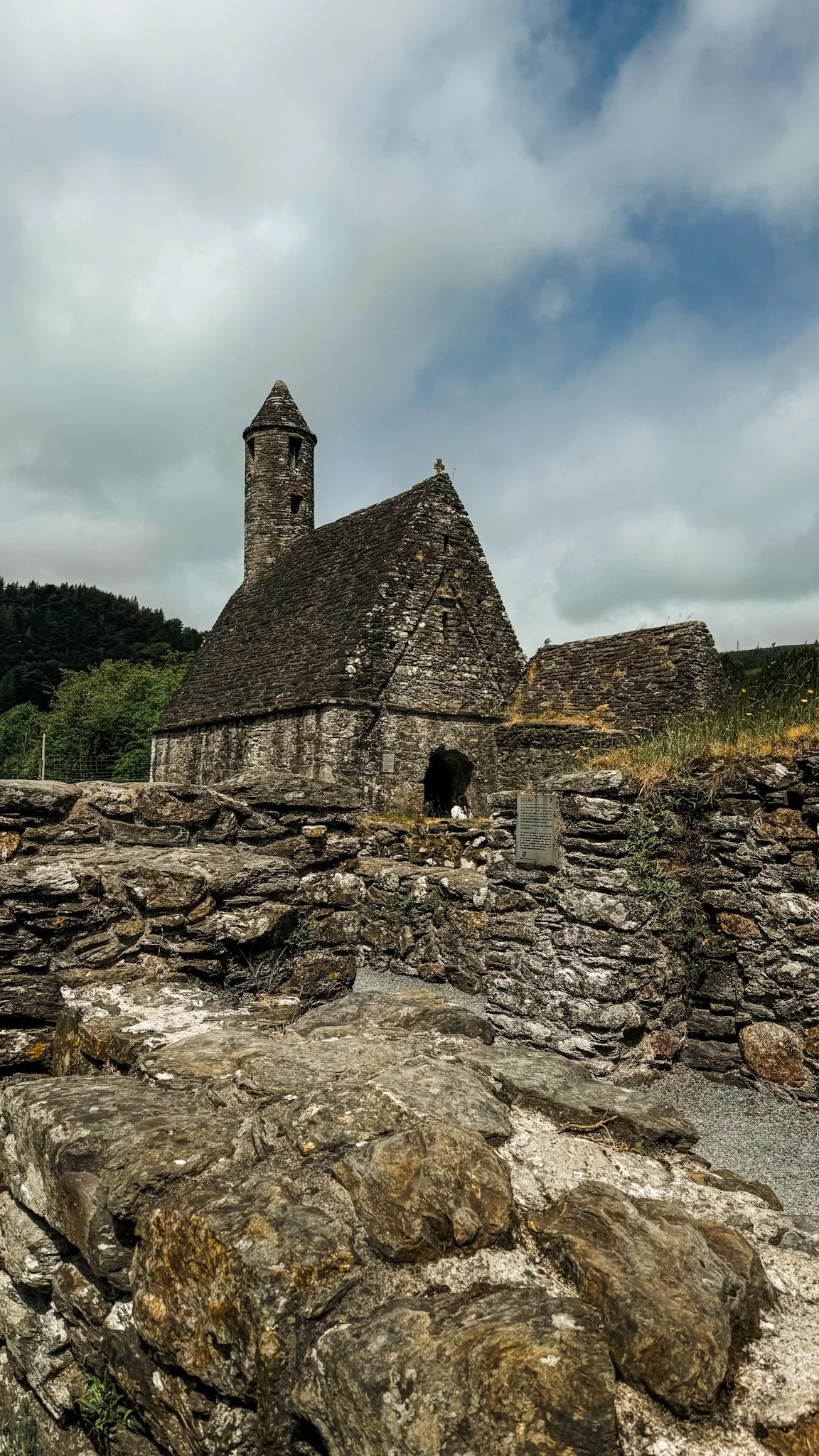
Glendalough is a monastic city founded by St Kevin in the 6th century but destroyed and abandoned in the 13th Century by the Normans. A number of the building, including the cathedral and various churches still stand in amongst the ancient grave stones. The round tower is the most iconic of the buildings, it would have once been used a bell tower but round towers were also used for defence against any attacker, including the vikings.

The girls, especially Hallie were impressed by the round tower. It does look like something out of Rapunzel.

Glendalough sites at the end of a glacial valley with two lakes, There are a number of trails throughout the mountains that start at Glendalough and head up into the towering moutains on either side. We opted to do a short, flat walk around the lower lake to the edge of the upper lake, which us through some magical looking forests and streams.

The day we went was very windy, one minute the skies were blue but then the wind would blow misty rain down the valley. On the edge of the upper lake, it wind felt like it was gale force! But we still managed to take in the views and watch a family ducks swimming in the waves.

Visiting Glendalough was surprisingly free of charge to enter, however there is a small fee for the main carpark and you can pay to go into the information centre to learn more about the site. There was a restaurant at the hotel that was right next to the visiter centre, which was were we had lunch. But there were a number of restaurant options in the nearby town, like the Wicklow Heather.

The Wicklow Mountains are really stunning, I can understand why many people prioritise this area when travelling to Ireland. i would like to come back one day and tackle some of the hikes up through the valley.

COUNTY WEXFORD: Secret Valley Wildlife Park

Earlier into our stay in County Carlow, we took advantage of a very sunny day and visited the Secret Valley Wildlife Park. The highlight were the Capybaras, the girls were very excited to see the worlds largest rodent in person.

Secret Valley Wildlife Park is a privately owned nature reserve. It has some of the typical farm animals like ponies, donkeys and rabbits but it’s also home to a lot of rescued primates like lemurs, macaques and tamarins. (which I surprisingly didn’t take any photos of.) We really enjoyed the animals talks that the zookeepers did for the primates. It’s eye opening to hear about the awful conditions some monkeys end up in due to the exotic pet trade in Europe. It’s not really an issue in Australia due to our strict animal quarantine laws but many people in Europe buy small primates as pets and quickly realises how inappropriate they are and then abandoned them. So it’s nice to see a place like Secret Valley Wildlife Park providing a home and caring for them.

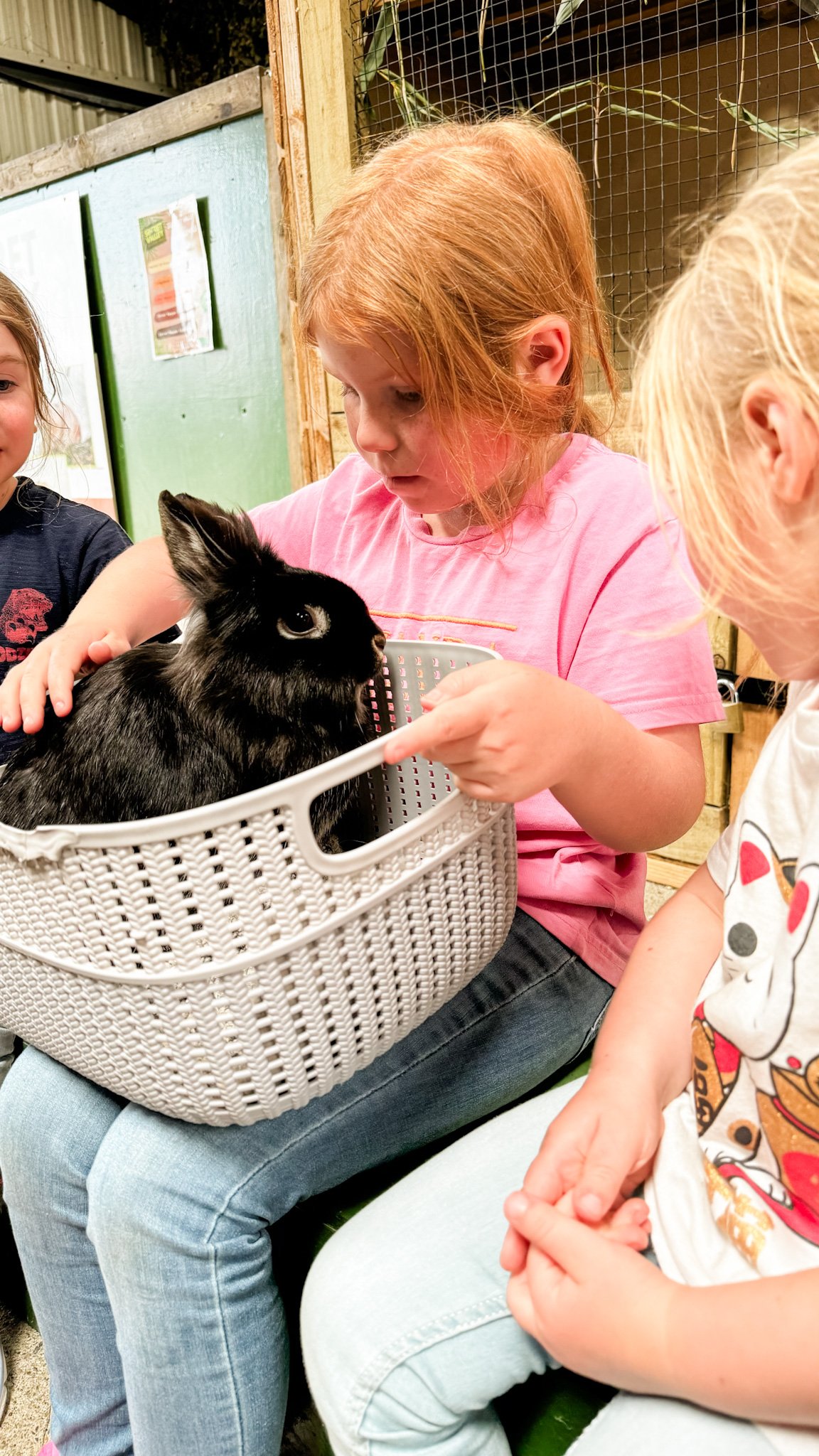
We also enjoyed hearing about the otters, meerkats and porcupine. And of course petting the bunnies and seeing the prairie dogs. There is a great cafe onsite with a big indoor inflatable jumping castle / obstacle course that the girls loves.

The grounds were really, large with a big kids playground and we were also given a scavenger hunt worksheet were the kids had to locate various different types of trees.

The girls really love animals, so any experience like this is always a great day out. We did skip the London Zoo and the Dublin Zoo due to the prices and the fact that major zoos can features very similar animals. But Secret Valley Wildlife Park was a great smaller location were we are able to see and learn a lot about the animals. We’d totally recommend visiting, especially if you have a day with lovely sunny weather.

COUNTY KILKENNY - Jerpoint Abbey, Remnants of a Sacred Past

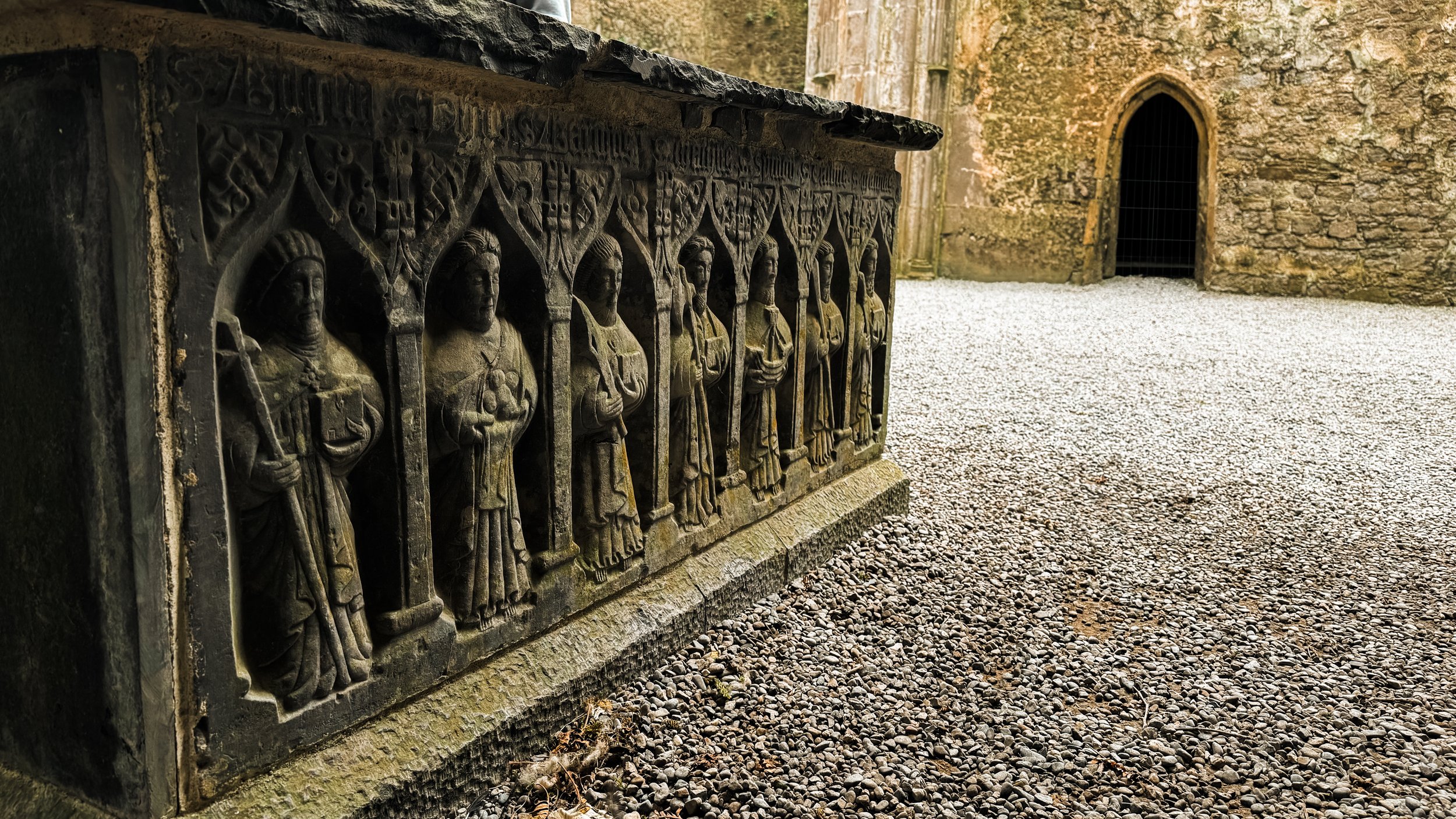
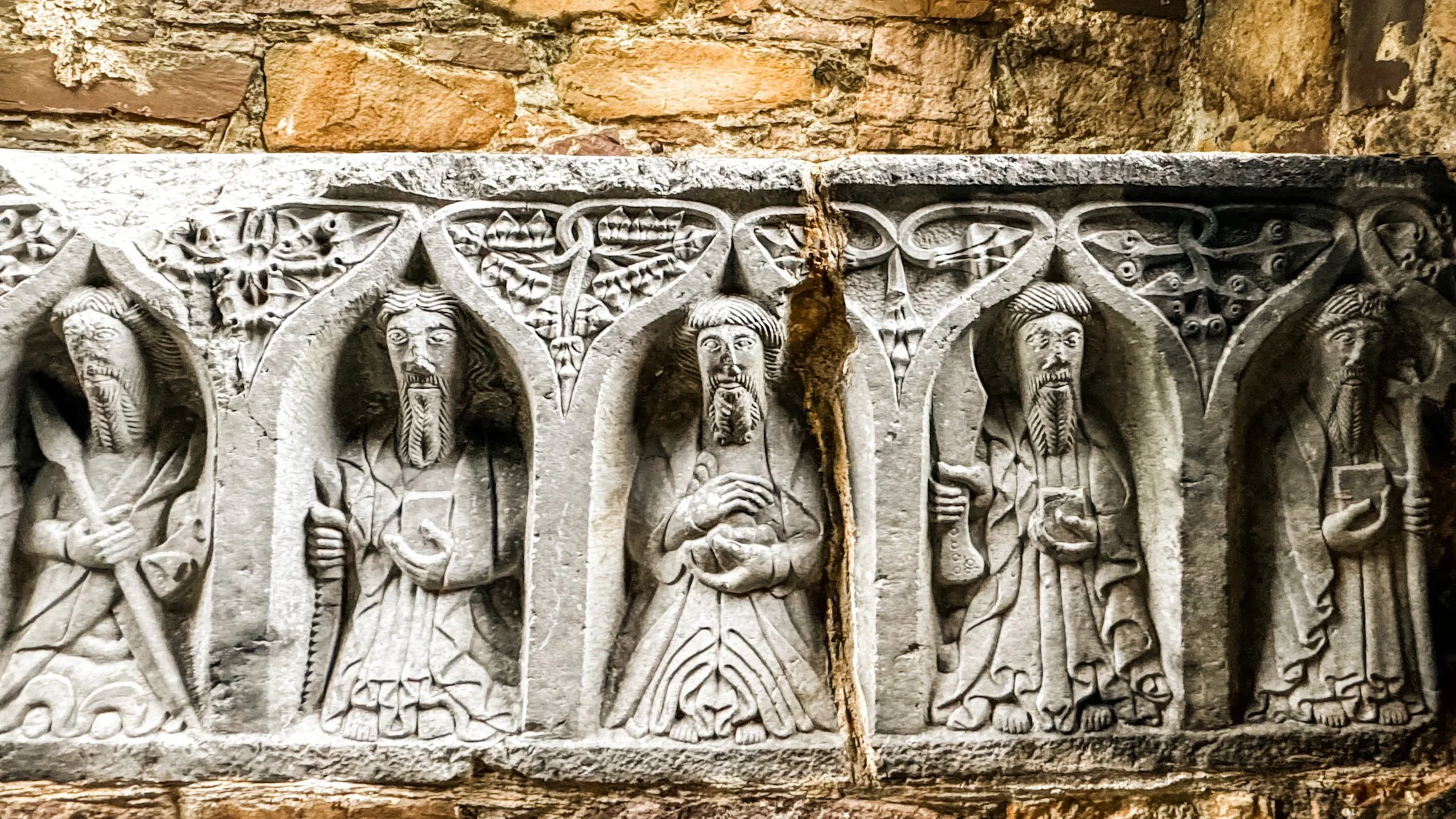
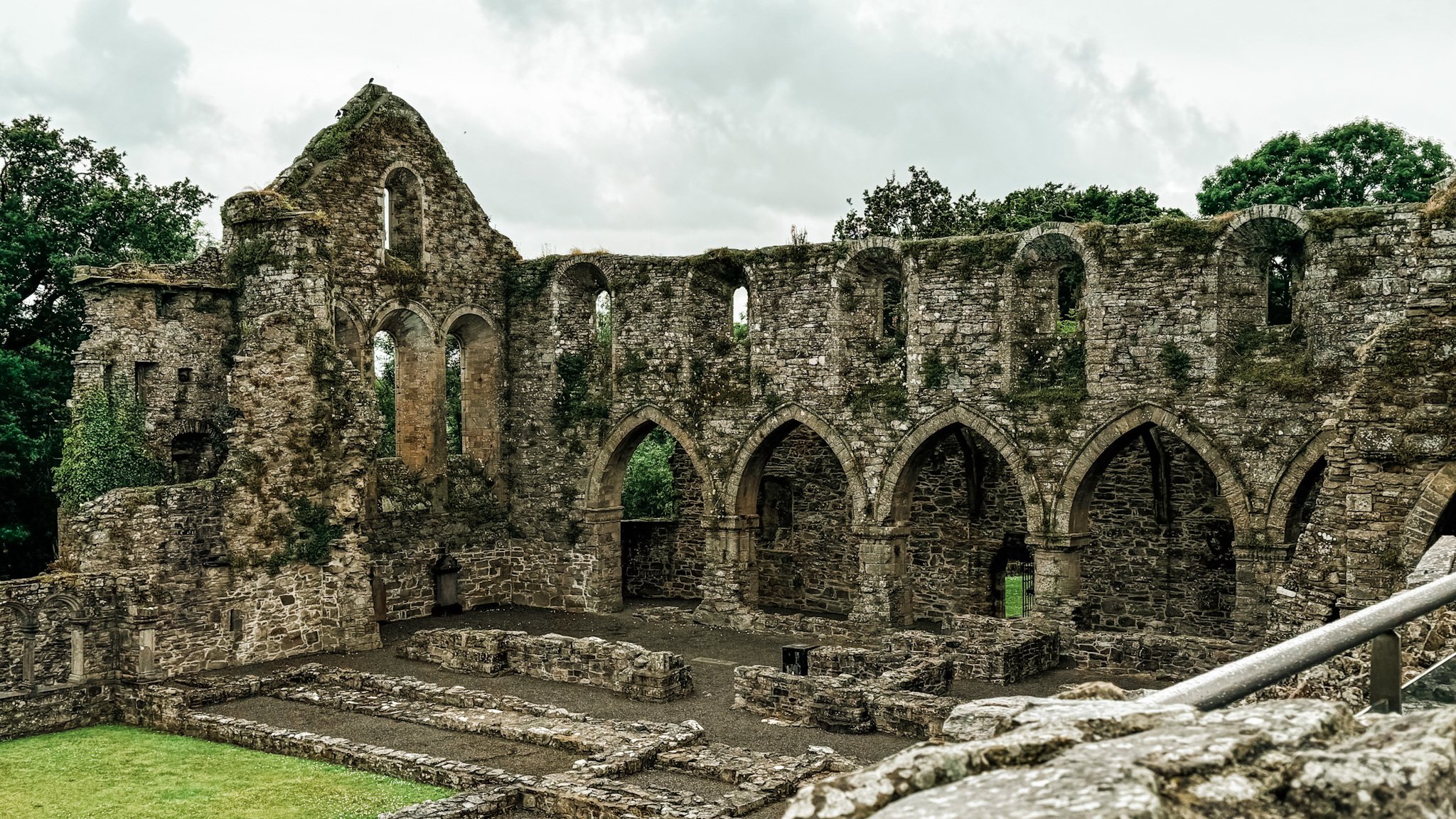
Jerpoint Abbey, located near Thomastown in County Kilkenny, Ireland, is a magnificent Cistercian monastery founded in the second half of the 12th century. I found this whole site to be so enchanting, with the evocative stone carvings, cloister arcade and greenery growing across parts of the ruins. I went a bit crazy with all the photos but there were so many beautiful angles and vantage points… enjoy!

Jerpoint Abbey offers a captivating glimpse into Ireland's medieval monastic heritage. Monasticism in Ireland began in the 4th and 5th Century with the arrival of St. Patrick and other missionaries who established early Christian communities . Prior to this, the Celtic tribes of ancient Ireland held pagan beliefs, with elements of Celtic spiritualism being incorporated into Christian beliefs over time.

Monasteries, like Jerpoint Abbey, became centres of learning, art, and spirituality, playing a crucial role in preserving knowledge and fostering education during the so-called "Dark Ages" in Europe. Monastic settlements often included churches, round towers, and high crosses, and they were influential in spreading Christianity throughout Ireland and beyond. Other notable monastic settlements include Clonmacnoise and Glendalough. (We’ve actually visited Glendalough since visiting Jerpoint Abbey, which I will share soon too, but I found Jerpoint Abbey to be slightly more impressive in size to the ruins at Glendalough, Glendalough is in an amazing location though… stay tuned)

Jerpoint Abbey was a thriving religious centre until the Dissolution of the Monasteries in the 16th century under Henry VIII, after which it fell into ruin. Today, the abbey is managed by the Office of Public Works and is open to the public. There is a visitor centre onsite and the staff were able to provide the girls with a fantastic scavenger hunt style worksheet where they had to find different carvings and different features around the abbey. These types of worksheets are such a fun way to keep them engaged and that the end, they all received a free postcard as a reward.

Sites like Jerpoint Abbey, that are managed by the Office of Public Work, do charge a small admission fee - usually 5 - 8 Euros per adult, but children under 12 are free.

I’ve always found ancient ruins and abandon structures to be so magical and mysterious. Its’ somewhat of an otherworldly experience to have a place like this all to yourself; to just wander around and take in the remnants of its spiritual past. There were a few other people that arrived while we are there but it didn’t feel crowded in the slightest.

It’s wild to think that places like this just sat abandon for centuries as society changed around them. There is such a haunting beauty to them;.and I’m grateful that they have been preserved and can be appreciated today.

COUNTY CARLOW - Borris Viaduct, A Bridge To The Past

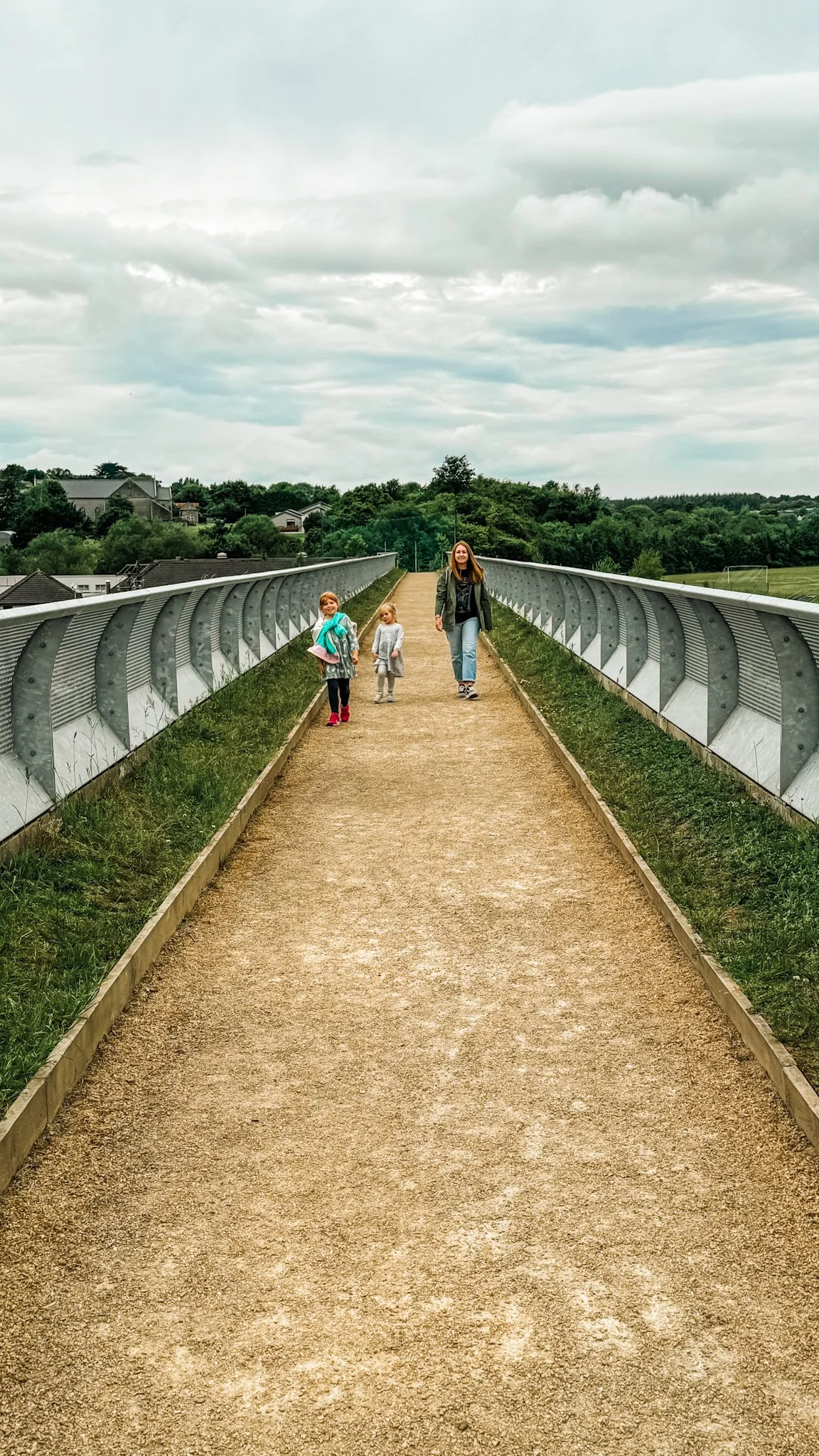
The Borris Viaduct is quite close to where we are staying, we drove past it a number of number of times before I realised that there was actually a short walk across the viaduct and picnic area underneath.

The 16 archway viaduct was built in 1860 as a railway bridge across the River Mountain. It is one of Ireland’s best examples of 19th century railway engineering. It was constructed as a part of the railway line from Bagenalstown to Wexford. The railway was decommissioned in 1967 and left abandoned, but in recent years, the council of the area have restored the area, making it safe for the public to enjoy to views from the viaduct.

There are a number of repurposed railway lines around Ireland, the Waterford Greenway being one of the stand outs. The traffic free paths along old train track are great for exploring the countryside on bicycle.

The Borris Viaduct is only a short distance from the main part of Borris town, making it great for a short leisurly stroll. There are free carparks on either side of the viaduct and picnics tables at one end by the bridge and underneath the viaduct. There is also fencing along the viaduct which makes it safer for children. (no public toilets however)

The views across the county side, to Mount Leinster and The Blackstair Mountains ,are quite spectacular and there is plenty of signage outlining the history of the viaduct. Which is where I read the catchy phase ‘a bridge to the past, a link to the future’

All up its 500m each way across the viaduct and another 500m on the loop track that goes underneath the bridge. The girls enjoyed playing ‘barky boats’ in the little stream that ran through the picnic area and have even asked go back. We’ll definitely aim to go back with a picnic lunch.

COUNTY CARLOW - The Brownshill Dolmen, An Ancient Portal Tomb

The Browneshill Dolmen, located not far from Duckett ‘s Grove, near the town of Carlow, is an impressive megalithic portal tomb dating back to approximately 3000 BCE. Renowned for its massive capstone, estimated to weigh over 100 metric tons, it is considered the largest of its kind in Europe.

I love the mystery that surrounds prehistoric monuments like this. They reflect the advanced engineering skills of Ireland's ancient inhabitants but leave a lot of questions unanswered. Like how did they move that huge capstone into place with out any machinery or even any large beasts? I asked Braino, who works in construction and is often around cranes and other machinery that lift heavy slabs of concrete and he was stumped. Archeologist believe the huge rocks were rolled along the ground on a bed of logs, but that’s just one of the theories.

The Dolmen, also known as the Browneshill Portal Tomb, consists of two large portal stones supporting the capstone, with additional stones forming the burial chamber beneath. They served not only as burial sites but also as ceremonial and ritualistic locations, reflecting the spiritual and social practices of early societies. Interestingly, there has been no excavation undertaken on the Brownshill Dolmen.

The girls wanted to go inside, under the large capstone, but I insisted they didn’t. There weren’t any signs saying not to but it seemed almost irresponsible to let your kids play inside an ancient portal. My friend Kayleen pointed out via instagram that in the show Outlander, the main character is transported back in time by entering a Scottish Portal Tomb. I haven’t seen the show but I guess time travel and teleportation seem to go hand in hand with a portal tomb and I wasn’t going to risk it 🤣.

The Brownshill Dolmen was situated in a farmers field, but there is a small dedicated carpark and signage, with a path leading out to the dolmen. It was free of charge and unattended by any staff. As we were leaving a father and son came to throw a ball around for their dog, so it isn’t a particularly popular tourist attraction, only people with weird niche interests like me would put it in their itinerary. But in saying that I would like to visit other dolmens, standing stones and stone circle while we’re here in Ireland.

COUNTY CARLOW - Duckett's Grove, A Historic Home In Ruins

Duckett’s Grove was one of the first excursions we did once we arrived in County Carlow and it’s still up there as my favourite place. I think it’s amazing that a location like this, an abandoned, crumbing ruin of a stately home, had been preserved and repurposed into something the whole community can enjoy. We had a fabulous day there, it’s surprising very family friendly.

Duckett’s Grove was built around 1745 by the wealthy Duckett family who originated from England. The estate was originally over 20,000 acres of land. The most notable member of the family, William Duckett, was a landlord and a significant figure in the local community. The Ducketts were known for their contributions to agricultural development and the improvement of local infrastructure. They were also involved in local politics and social affairs, often hosting grand events at Duckett's Grove. The building started as a standard two storey Georgian county home but in the mid 1820’s, John Dawson Duckett employed English architect Thomas Cobden to resigned it into the gothic revival style ‘castle’ that stands in ruins today.

However, like many Anglo-Irish families, the Ducketts' fortunes declined in the early 20th century, exacerbated by changing political and social conditions in Ireland, leading to their eventual departure and the estate's decline. In the early 1920’s Duckett’s Groves was used as a base for the IRA (Irish Republican Army) and was then damaged by a fire in 1933 and left abandoned for many decades. Around the 1970s an eccentric lady by the name of Frances Grady moved in, essentially squatting in a section of the manor. She welcomed in abandoned and neglected animals, creating an animal refuge and enlisted the help of local children who she would teach how to horse ride in exchange for doing chores and helping with the animals.

There is much more to the history of Duckett’s Grove, it’s such a fascinating place full of interesting characters and stories. We learnt so much from our guide Danny, who was absolutely fantastic when telling all the takes of Duckett’s Grove. He was so passionate and engaging. The tour was absolutely free but we did book in advance as Danny only runs the tours twice a day on Friday, Saturday & Sunday. We spoke with Danny for close to two hours, while walking around the grounds and the outskirts of the property. The girls were amazingly well behaved during the tour, which Braino and I appreciated because we were so enthralled by what Danny had to say.

Obviously, you can’t go inside the buildings of Duckett’s Grove, as most of it is a state of crumbled, overground ruins. However it is frequented by paranormal investigation groups who do actually go inside as they have specialised liability insurance. There are a number of ghost stories associated with Duckett’s Grove, including a curse, a banshee and the ghost of William Duckett himself.

In a spooky turn of events, after visiting Duckett’s Grove, I was listening to a podcast about it and found out that William Duckett, the last of the Duckett’s to live at the estate, died on the 22nd of June 1908. And guess what day we happened to visit?…. the 22nd of June. Spooky coincedence or just a random occurrence?

In 2005 the Carlow County Council acquired Duckett’s Grove and restore the two walled gardens at the rear of the property. It has been open to the public since 2011 and some of the stables in the rear courtyard have been restored and now house a tourist information booth, a small gift shop, and The Lazy River Cafe. In the surrounding wooded area, there is a lovely obstacle course style playground that the girls enjoyed playing on. As as were there on a Saturday, there was quite a lot of people enjoying the cafe and playground, even a group of girls around the age of 10 having a birthday party.

There are many old historic homes like this across Ireland in varying states of preservation and I love that a place like this has been somewhat preserved for use by the public.

DUBLIN - 2 Days in Ireland's Capital

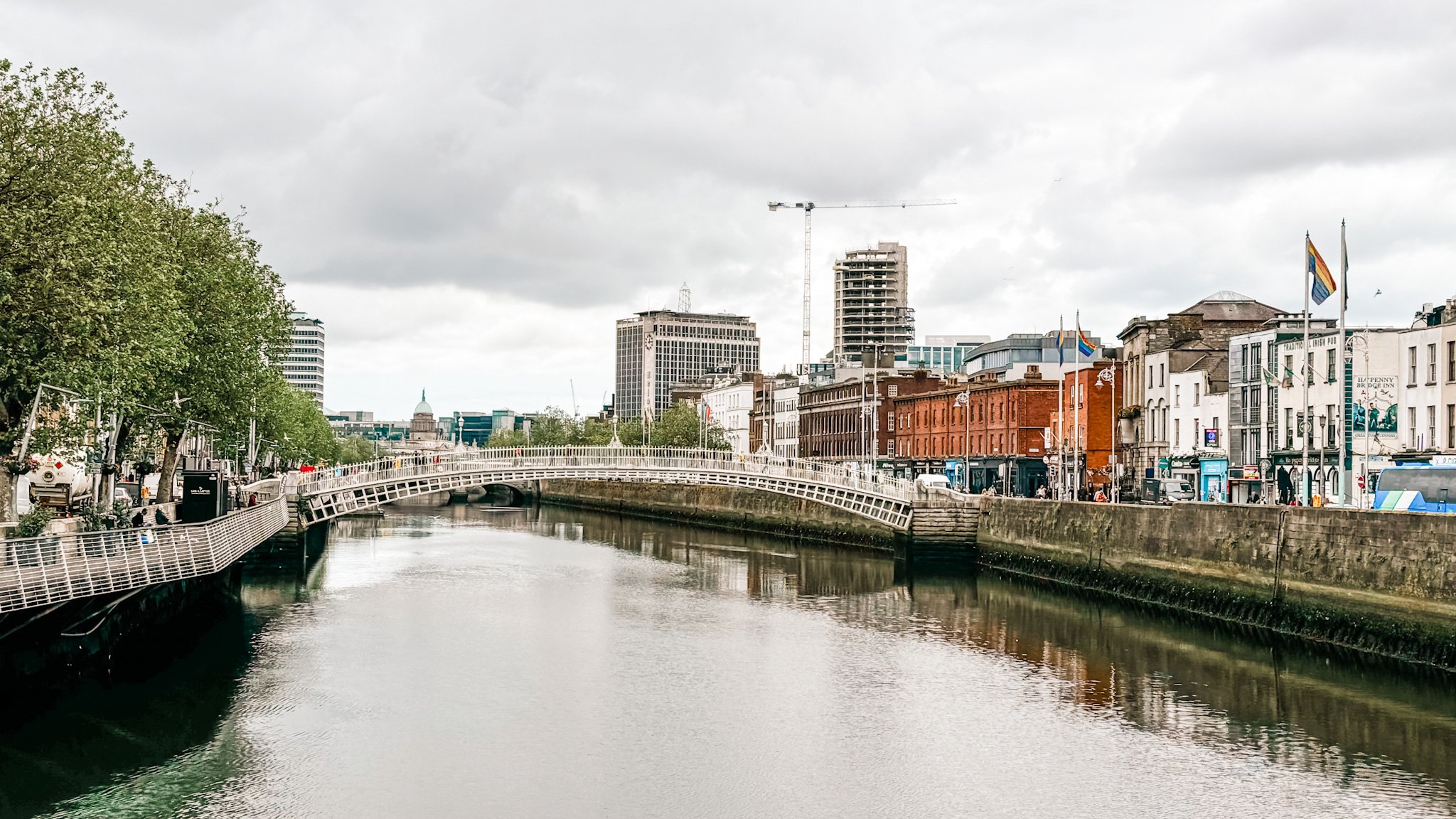
We loved Dublin! We were there for two full days and we really just enjoyed wandering around and hanging out in the city area. It had a great vibe and we had lovely weather too which helped! After the enormity of Japan, Singapore and London, Dublin felt very chilled and unhurried.

We actually stayed about 40 minutes south of Dublin in an area called Dun Laoghaire, (pronounced Dun Leery ) which is a lovely seaside suburb. We were still relying on public transport at this point but we found a bus stop right next to the accommodation that went straight into the city. We had booked an aiport transfer again from the airport to the hotel, whihc were on opposite sides of Dublin. Airport transfers are so worth it!

We stayed at a hotel called Rochestown Lodge Hotel, which was great. We booked it based on the price and included amenities, not necessary for the location, considering it was quite far from the city centre. We had a family room which was very spacious and had a seperate room for the kid’s beds. The hotel had an indoor pool which the girls loved, Braino took them swimming every afternoon! The hotel also had a great restaurant which we had dinner at every night as it was just convenient. The hotel was located in a kind of suburban area so there wasn’t any restaurants within walking distance and we didn’t have kitchen facilities.

Out and about in Dublin

One unique thing we did in Dublin was the National Leprechaun Museum. Well it was just myself and Farley who went, Farley has been very interested in mythological creatures for the last year or so, so it seem like a fitting experience for her. 

However, upon closer inspection, the name National Lepruchaun Museum serves more to attract attention of tourists. The musuem itself is more of a story telling experience, where small groups are treated to various different tales from Irish folklore, including Leprechauns. Oral storytelling is an important part of Irish history, so the museum is dedicated to preserving that, rather than any particular artefacts or evidence of Leprechauns, which I imagine some people would be disappointed by if they hadn’t really research the museum before going. It was a great experience which I think Farley enjoyed, she was certainly brave, as we were lead through a lot of spooky, atmospheric spaces in museum to hear all the different folklore tales. (edit: since writing the first draft of is post, I asked the girls whats one thing we’ve done in Ireland that they enjoyed enough to do it again and Farley’s answer was the Leprechaun Musuem, so she definitely enjoyed it… maybe we will go again, who knows )

Afterwards, we of course went to the Temple Bar area which is the touristy pub area of Dublin. We had a Guinness in the iconic red Temple Bar Pub on the corner, which was actually Braino’s very first Guinness. With kids, we obviously didn’t stay too long in the pub but it had a fun lively atmosphere. 

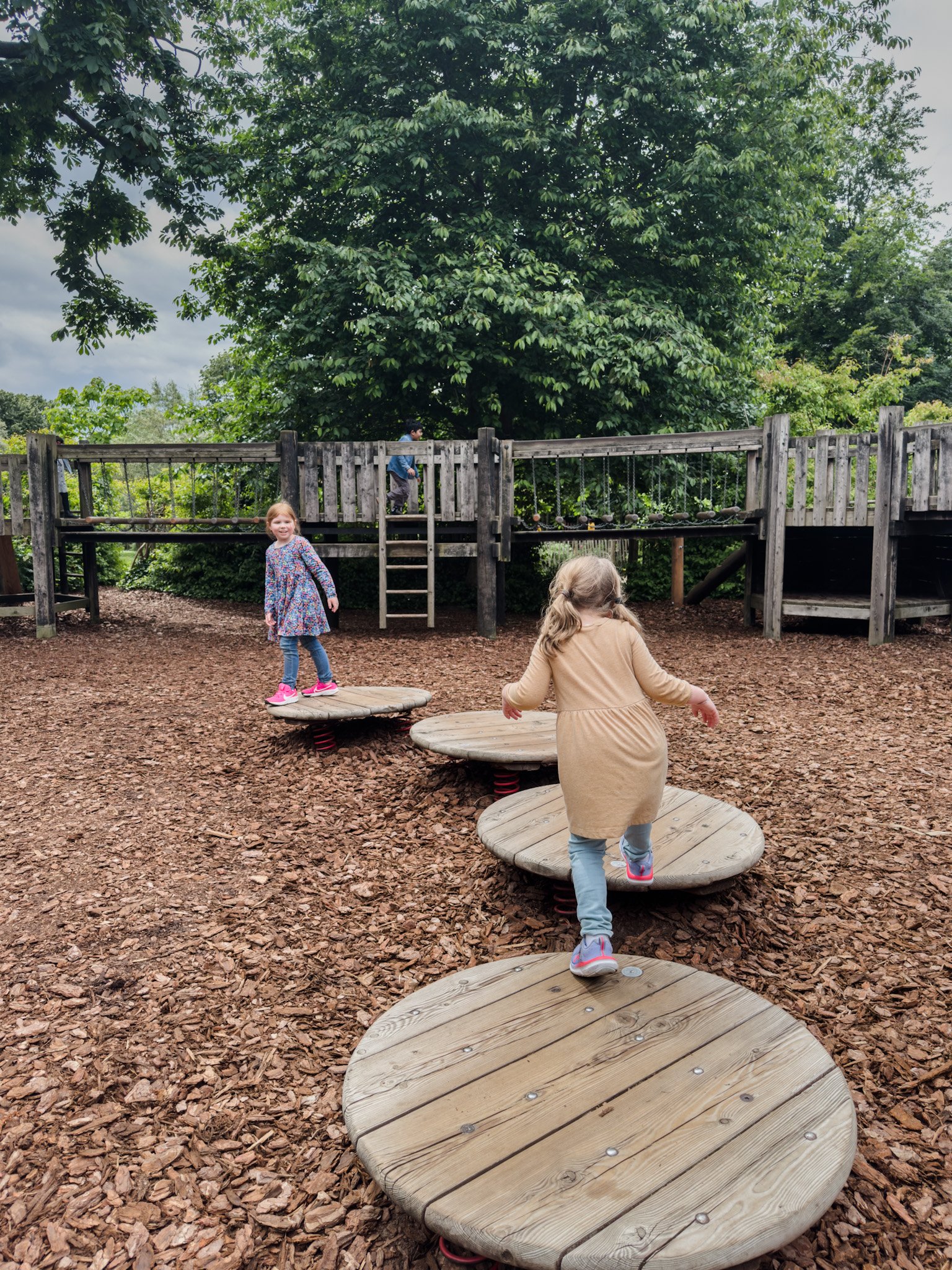
The other place we loved in Dublin was St Stephen’s Green, which is a lovely park in central Dublin It had a great playground for kids and a pond with swans and ducks. We even saw a baby swan. (photo below)

We also had a look in the Natural History Museum and the Archeology Musuem. Both were free and not far from St Stephen’s Green. The Natural History Musuem was very small and mainly just filled with taxidermy animals, apparently it’s colloquially known as ‘The Dead Zoo’. But the girls actually kind of liked seeing all the animals. I was quite interested in the Archeology Musuem but it didn’t really hold the kids attention for long and we arrived pretty close to closing time. 

We also wandered over to St Patrick’s Cathedral but we found that it was closed during that time (it was a Sunday, so the opening times were sporadic compared to other days ) but there was a great playground and garden right next door so we didn’t mind, it wasn’t a far walk to get there.

On one of the days we spent the afternoon wandering through Dun Laoghaire. We caught the train there from Dublin and enjoyed another playground in the People’s Park and an ice cream from Teddy’s, which is apparently quite iconic to Dun Laoghaire. Fun Fact: in Ireland they call a soft serve ice cream with a flake a ’99’. 

The girls had the best time climbing and playing along the rocks on the shoreline, which was a really peaceful way to spend the afternoon. 

After our two days in Dublin we picked up our hire car, well actually Braino headed off across town to pick up the car and purchase kids car seats while I took the girls back to the playground in Dun Laoghaire. After a whole month of relying on public transport, it was such a welcome change to have a car. We especially needed it in the countryside of Ireland, where public transport is close to non existent. 

A few other musuems and points if interest in Dublib that I had researched were:

Dublinina - a interactive museum that is geared towards kids and focuses on Viking and Mediaval Irish history. It’s right next to Christchurch Cathedral and you can get a ticket that covers both.

14 Henrietta Street, Dublin - This is a museum in an a tradition townhouse that captures over 300 years of what life was like in Dublin - from tenement dwelling to Georgian Townhouse

The Guiness Store House - This is tour of the brewery and museum of sorts aboust the history of Guiness. It looks really interesting but we couldn’t justify the cost with kids our age.

LONDON - Amazing Playgrounds & Animal Encounters

We were amazed at the quality and quantity of playgrounds in the central area of London. 

The playgrounds are all beautifully landscaped with a charming wooden aesthetic - no plastic playgrounds insight-  and best of all,  they are totally free to enter!

Diana Memorial Playground - Kensington Gardens

Our absolute favourite was the Diana Memorial Playground in Kensington Gardens, next to Kensington Place, where Princess Diana lived at one point. 

It’s a fitting tribute to Princess Diana and is inspired by Peter Pan, evoking a true sense of NeverNeverLand for children. There are many different sections, separated by hedges and landscaping, with all sorts of forts, clubby houses, swings and  climbing structures. The central focus of the gardens ins the huge wooden private ship that is surrounded by sand and water play. 

While it would be easy to lose track of your kids amongst all the foliage and hidden sections, the whole playground is fences with only one entry point that is manned but park staff, so there is no chance of kids running off complete. In fact, adults who are not with children are not allowed to enter. 

We were there on slightly rainy weekdays so it wasn’t crowded at all, however the website indicates it can be very busy at times and you may have to queue to get in. 

Afterwards, we enjoyed walking through Kensington Gardens, watching the swans and ducks in the ponds and spotting all the squirrels that can be seen running around. Squirrel spotting became one of the favourite things for the kids to do. You can find squirrels in most of the large parks around London and they can be quite confident when approaching people - I guess they are used to being feed. We also saw a fox in Hyde Park which was very exciting, although it was hiding in the bushes.

We also found an amazing playground near Hyde Park Corner, not far from the Knightsbridge Tube Station and near the dining area at the end of the Serpentine Lake. (also not far from the Natural History Musuem)

There was also a great playground super close to Buckingham Place, the St James Park Playground. 

And also right next to the London Eye in the Jubilee Gardens. 

All of them catered to toddlers right through to young teenagers, with plenty of climbing structures and obstacles. They were all fenced which means parents can also relax a bit and maybe enjoy a coffee. Our girls loved the playgrounds, it really helped break up some of the long walks and kept them in good spirits.

LONDON - The London Eye & Other Iconic Sights

Big Ben was our biggest priority in terms of London sights as Hallie has had a unqiue fasinaton with Big Ben (or more correctly - Elizabeth Tower ) ever since she found out about it at kindy. So we decided that the London Eye, with its spectator view of Big Ben and the Houses of Parliament would be one thing to splurge on.

It was definitely a budget buster but it was worth ever cents! The views were amazing! And it was suprisisng not anxiety inducing being up that high. The little pods seems really stable and spacious, I could bear feel it move and I din’t feel at all dizzy when I looked down from the top.

One recommendation I would make is: pruchasing your tockets online in advance will give you a slightly cheaper prices. We purchased the tickets onsite and didn’t have to wait long at all to get on.

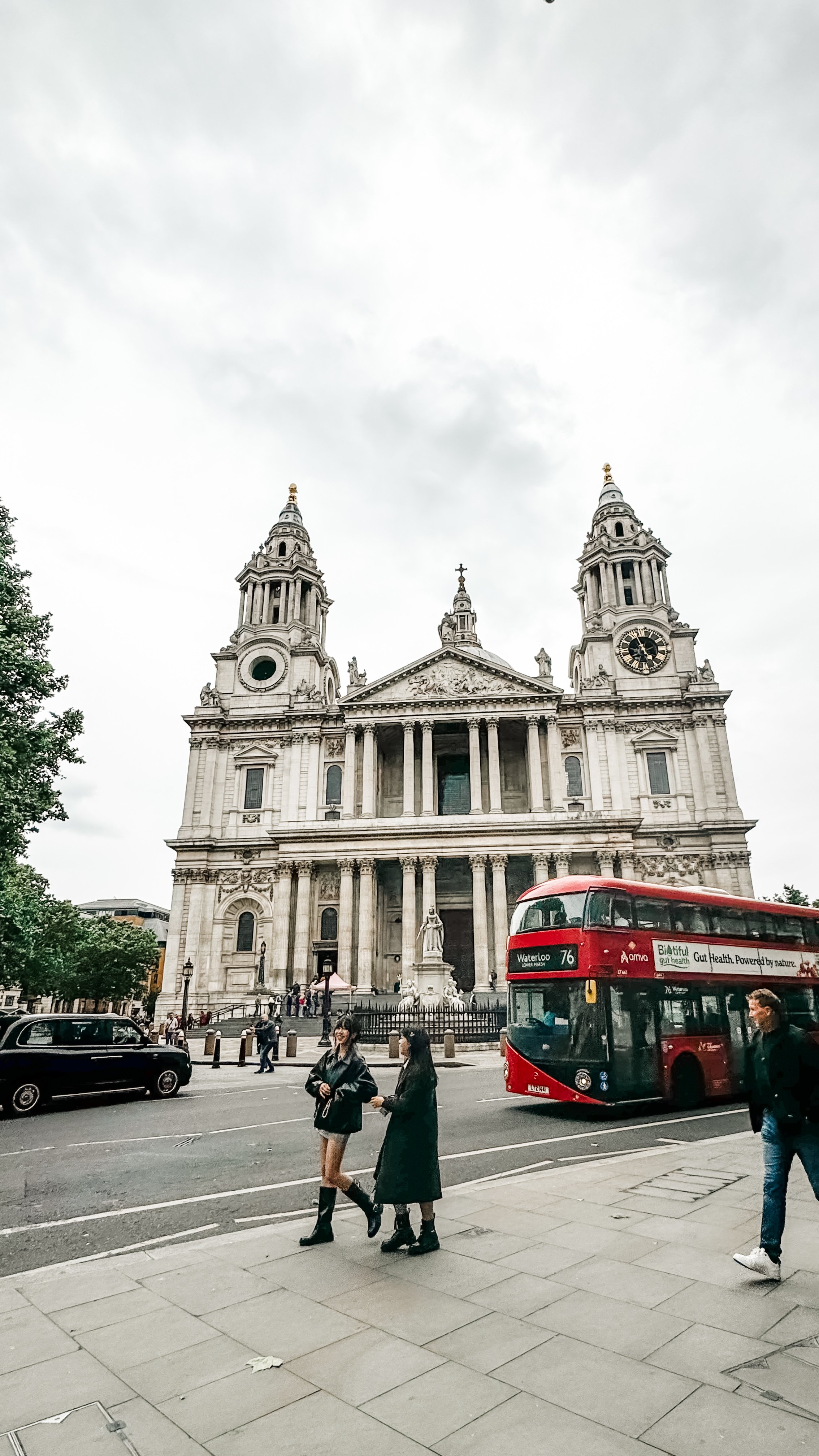
Below is the exterior of St Paul’s Cathedral. We didn’t go inside and we actually didn’t go into Westminster Abbey either. St Paul’s Cathedral is around 60 pounds for a family of 5 while Westminster Abbey would have been around 90 pounds, so we couldn’t really justify the price, maybe if the kids were a bit older, old enough to really understand the significance of each church.

Below is the Globe Theatre, a recreation of the original Globe Theatre that was constructed to house the performances of Shakespearean plays. We paid to do the guided tour which in a large group and went for about an hour. The girls were really great during the tour, very patient and listened intently. Both Braino and I enjoyed the historical context of what London was like during Shakespeares life.

I’ve always had a mild interest in Shakespeare and his works. I do remember studying MacBeth, Hamlet and Romeo and Juliet at high school and one of the short films we made at uni was inspired by Macbeth as well. Farley has a general understanding of who Shakespeare is just from references she has picked up from books and shows and also the fact that the moons of Uranus are named after character from Shakespeare’s plays. She had a big planets and space phase too.

After the tour there was an afternoon performance of The Taming of The Shrew, which I decided to stay for. This is actually the play that the movie Ten Things I Hate About You, which one of my all time favourite movies. I purchased the cheap 5 pound standing tickets which meant I had to stand up in front of the stage for the whole 2.5 hour performance, but it wasn’t too bad really. the performance was impressive - how actors remember all those complicated Shakespearean lines of dialogue is so amazing, but the hodge-podge, op shop chic costumes kind of left me a little confused. I was expecting full on historic Shakespearean costumes. Initially I was hoping the whole family could watch a show at the Globe but it would have honestly been hard for the girls to follow along. And the sitting tickets were definitely not cheap.

Whether you’re a big fan of the Royal Family or not, I feel that visiting Buckingham Place is a must see sight in London. You can actually go inside and do a tour but it’s only available for a very narrow window of time from July to September, it’s around 32 pounds for adults and 13 pounds for children over 5 years old. Farley has had a bit of phase of interest in the royal family so it’s always a special thing to be able to show her sights like this for real, not just in books and video.

The two very iconic sights of The Tower Bridge and the Tower of London are right next to each other, further east along the Thames from Big Ben and the Houses of Parliament. You can do tours inside the Tower of London, which actually houses a collection of royal crown jewels and also the TowerS of the Tower Bridge, however we decided to forgo any inside tours and just enjoy the sights from the outside.

We actually found a Wagamamas restaurant right next to the Tower of London! Wagamamas went out of business in Australia in 2014 but it’s still going strong in London, it was our favourite restaurant so Braino and I were excited to take a trip down memory lane.

LONDON - Family Friendly Free Museums & Art Galleries

I won’t detail out what we did on each individual day In London because it’s all a bit of blur now but I’ll recap our highlights to perhaps give other families an idea of what kid friendly activities there are in London. This post will focus on some of the free museums & art galleries. 

We were obviously conscious of our budget and the fact that one Australian dollar is worth basically half a British pound had us second guessing the necessity of every purchase. But I was quite surprised by how many free attractions there are in London so we actually experienced London is a relatively budget-friendly way. 

Natural History Museum 

One of our highlights was the Natural History Musuem which is absolutely free! It’s a huge collections of all things zoology, palaeontology, geology and mineralogy, including animal specimens that were collected by Charles Darwin! The architecture of the main building is simply breathtaking and the main hall features a blue whale skeleton suspended from the ceiling. (Interestingly, the blue whale’s skeleton was found in Wexford Harbour, Ireland in 1891 and was in storage for 42 years before being displayed in the hall with all the other whale and animal specimens. It moved to the main hall in 2017, replacing a skeleton cast of ‘Dippy’, the Diplodocus )

The girls loved the huge array of taxidermy animal specimens and I was particularly excited to point out the ichthyosaur fossils that were discovered by Mary Anning, a girl from the south of England who we had read about in a book we purchased from the Queensland Musuem called ‘Stone Girl, Bone Girl’. We also discovered that the Natural History Museum is the musem from one of the girls favourite shows ‘Andy’s Prehistoric Adventures’ and we were able to locate the clock that is used in the show.

We spent a good solid hour in the geology area of the museum which has countless rocks and mineral specimens, including gemstones. It also features a gallery dedicated to natural disasters like earthquakes, volcanos and tsunamis. This was particularly interesting after our time in Japan. Actually, in the Natural History Museum is as a room that is designed to look like the interior of a grocery shop in Kobe Japan which shook, replicating what it would feel like to be in the earthquake that occurred in 1995. There was even CCTV footage playing on small TVs from inside the shop at the time of the earthquake. After being in Japan and seeing a volcano - Mt Fuji - and learning about Tsunamis from seeing warning signs on the beach of Kamakura, it was a great experience for girls to see all the information presented in a museum format. 

The other huge highlight for us was the dinosaur section where they have a massive robotic T-Rex, which roars and moves! Initially, we had seen a short clip of the T-Rex on a YouTube video and the girls said they would be too scared to see the T-Rex for real but after a bit a pep talk from Braino and I, the girls braved it and loved the T-Rex! Such a relief, because it was really impressive. 

I would absolutely recommend the Natural History Museum! It’s amazing that its’ free and while it is recommended to book a time slot online, we did and it didn’t seem necessary on the day. It’s located ver centrally in South Kensington, not far from Hyde Park and Buckingham Palace. 

Science Museum 

Right next door to the Natural History Museum is the Science Museum, which is also free to enter and there are loads of exhibits included in the free admission. So much so that you could really dedicate a full day here. After an hour or so we felt a bit museumed -out and there were still many levels we hadn’t gone to yet. 

I feel like the Science Musuem would be amazing for slightly older kids, even teenagers - like maybe 10 years and up. There is an amazing collection of airplanes and space shuttles and other feats of engineering. Our girls loved the area called ‘Who Am I’ which explores genetics, in particular the touch screen interactive games that focused on health, physical changes and peoples different appearance. 

If I were to dedicate a full day the Science Musuem, I would buy tickets to the Wonderlab area, which is an interactive area for kids to learn in a really hands on way. It looked rather similar to the SparkLab Centre at the Brisbane Museum, which is why we didn’t initially prioritise it. 

I’d also book tickets to one of the different nature based IMAX movies that are showing like Antarctic 3D and Ocean Odyssey. 

Tate Modern

The Tate Modern is a huge art gallery, housed in a gigantic old power station on the banks of the Thames, near the Millennium Bridge and next to Shakespeares Globe. It was refurbished in the late 90s and opened in 2000 as a stunning gallery for modern art. It’s free to enter and there are a few sections that are kid friendly, we spent about an hour and a half there before visiting the tour at Shakespeares Globe Theatre. 

There is a section in the foyer area with books, colouring in and blocks for toddlers an d young kids to play with while parents chill out on the surrounding couches. There are also a few digital art stations around the gallery were kids (and adults) can create art on a iPad style screen and then see their artworks appear in the large frames along the walls above. 

We also wander though one of the galleries full of art - there is so many different levels of galleries, we just found the closest one to have a look at. Some of the modern art was bizarre and kind of creepy, some of it raised a few questions from the girls, but overall, it’s always thought provoking and educational. It’s free to enter and depending on how patient your kids can be when it comes to modern art, you could easily spend a couple of hours there. 

The British Museum 

This is one of the only really disappointing things about our stay in London. We intended to go The British Museum which is also free to enter, but one the afternoon that we went, we found that the line to get in was out the front gate and down the street. It was actually our last full day as well, as we had no option to come back another day. We didn’t book tickets in advance but I’m not sure that would have made a difference as we couldn’t even see a separate line for ticket holders. It was kind of mind blowing to see the line that long. We were there for about 15 minutes and the line didn’t move at all, so we decided to call it a day and not wait around. 

The British Museum has an extensive collection of ancient artefacts, including Egyptian mummies. I have been many years ago but I only have vague memories of it. It would have been a good learning experience for the girls. So if you do have your heart set on visiting the British Musuem, I would recommended booking a ticket online, even though they are free, and arriving first thing in the morning. 

Other suggestions 

Another free Musuem that we didn’t go to but would be interesting is the Victoria and Albert Museum, which is located right next to the Natural History Museum and Science Museum. It a museum / art gallery that focuses on art,  design and performance, for example there is an upcoming exhibit focusing on the songwriting and costumes of Taylor Swift. 

There is a Young V&A which is further across London in Bethnal Green, near the Tower of London. It appeared to have similar themes to the V&A just in a more interactive format for kids. 

The Discover Children’s Story Centre was on our list but we didn’t make it as it was a little further east, beyond the Tower of London and it also required paid tickets. It is basically an imaginative, indoor play space that is themed around storytelling. It says it’s designed for babies to 11 year olds but I would say, from the looks of the website, it’s probably great for toddlers and younger kids rather than 6 and above. But that’s just my guess. 

IN TRANSIT - From Singapore to London

I absolutely love London and arriving in London felt like reuniting with an old friend. 

Even though I’ve only visited London for short periods of time on three different occasions many years ago, it feels like I have a certain familiarity with London. Maybe because it’s featured so much in history lessons, literature, movies and monopoly, but it was a great feeling being back in London, recognising all the buildings and tube station names. 


Traveling from Singapore to London

The flight from Singapore to London was an extremely long journe.y I have to hand it to parents who fly from Australia to the UK in one journey, it’s so long to be sitting on plane, I can’t even imagine what it would be like to keep a toddler occupied for that length of time. 

We flew out of Singapore at midday but we would have woken up around 7am that morning so we could get to the airport with plenty of time to look around again. Singapore Airport is so amazing efficient, it was no stress at all. 

The girls were great on the plane;  the inflight entertainment kept everyone occupied, we didn’t need to even get out any of the games or colouring or the iPad. It was the first flight where we have had meals and inflight entertainment included , so we were all excited to just binge watch whatever we wanted to for the next 13 hours. I watched an amazing documentary about Alanis Morreette and a few other cheesy rom-coms and then The Killing of The Flower Moon with Leonardo DiCaprio and Robert De Niro which was three hours long! And I missed the last 15 minutes because the damn flight was landing and I had to get off, haha! 

The food was honestly excellent too, obviously relative to airplane food in general. The only downside of the whole flight was that no one really got an sleep. Rooney slept for about 3 hours and Hallie maybe for an hour or so, but Farley - not at all. Neither did Braino or I. We landed in London at 7pm London time, but that was around 2am Singapore time, so it was a very long day. 

One thing we have decided is that airport transfers are 100% worth the money. We had one arranged for when we landed in London (which we booked through booking.com) and he was able to meet us at the arrivals gate and take us straight to our accommodation. Which was an absolute blessing after such a long flight. 

Jetlag

I’ve never been to London in the summer months, only in winter and early spring, so it was a bit of an adjustment getting used to the longer daylight hours. We arrived at our accommodation around 10pm and it was still daylight, or just on sunset. Which actually worked out well as we just had showers and went to bed and were able to get a full night sleep and wake up at a usual morning time the next day.

I thought this would  help a lot in terms of avoiding jet lag. We did manage to get out and about the following day but it seemed like jet lag really hit on the second day. It was mainly Farley, she never naps, getting her to nap as a baby was such a mission, but she was the one that fell asleep on a train in the middle of the day. I certainly felt tired every night, and slept well for the whole week we were in London. 

The accommodation 

The accommodation we were staying at was one block back fro Edgeware Road, north of the Edgeware Road Tube Station on the Bakerloo Line (for those of you who may be familiar with London) It was a two bedroom apartment that we booked via booking.com and it was overall ok. The building itself was about 20 floors high, (we were on floor 17) with four apartments on each level. It kind of reminded me of an old disused uni campus that we once shot a short film in during my film school days. It was probably built in the 70’s and felt a bit like a council flat.

Fortunately the interior of the apartment was in better condition, but only just. The bathroom was in need of an update, there wasn’t a plug for the bath and the thing that holds the shower hose onto the wall had broken off so showering was a annoyingly tricky. But at least the water was hot! Little things like that could really get under your skin, but Braino and I have been good about putting things into perspective and focusing on the bigger picture. I’m mean we’re traveling the world for a whole year, a dodgy bathroom is really just a minor inconvenience in the grand scheme of things. And anyway, I kind of feel like that apartment was probably pretty standard for London, in that price range anyway. 

Actually, initially we had booked a hotel room in a hotel on Sussex Garden, which was off Edgeware Road, a little closer to Paddington Train station and Hyde Park. 

It was actually the same street I stayed on with my family when I was there in 2007 and I remembered the location being fairly central. From memory it would have included breakfast but it was only a hotel room with 4 or 5 beds in it. And after the Sinagpore capsule hotel accommodation and even the small room we had in Tokyo, Braino and I decided to see if if we could find something a little bigger, like a 2 bedroom apartment. And we were fortunate that the original accomodation was refundable and that we could find the new accommodation in a similar area for a similar price.  

The kitchen, dinning room and lounge area made such a difference for the week. We were able to buy groceries and cook dinner every night. Obviously the  exchange rate to British pounds is a huge thing to factor in, so being able to eat breakfast and dinner at home and even occasional pack a lunch, meant we could keep the budget in check. Also, the kids go a little crazy in restaurants after a long day. I’ve started bringing Uno or a pack of cards out to restaurants just to give them something to do while we’re waiting for our meals. 

I’ll share more about what we did  during our stay in London in the following post…. 

SINGAPORE - Our 2 Day Itinerary

Singapore is a wonderful family friendly location; there is so much do, you could easily fill out a week or more holiday. 

While Singapore is a rather expensive destination, we found there were some incredible kid friendly, free options available to fill our our two day stopover. 

First up, we purchased tickets to the Art Science Museum at Marina Bay Sand where there was a TeamLab exhibition called FutureWorld. The girls absolutely loved TeamLab Planets in Tokyo, it still rates as their most favourite activities so far. Future World has similar digital projected artworks that reacted to the movements of the guests, as well as a large animated artwork where you could design your own plane, bird or butterfly, scan it and see it come to life with in the artwork. 

From the outside, the Art Science Museum is a really unique building, its lotus flower inspired design was created by architect Moshe Safdie. It is next to another one of Singapore’s spectacular building, Marina Bay Sand, the iconic three buildings with the boat like platform at stretches across the top of all three. 

We walked through the shopping arcade at the base of Marina Bay Sands and were wowed by all the high end designer brands and theatres. 

Our next destination was the Keppel Centre for Art Education, located in the National Gallery Singapore. This was a fantastic FREE experience for the kids, with so many hands on, engaging, creative based activities. We easily spent a couple of hours here and girls were kept busy with the multiple different rooms and artistic activities. We were fortuate to be there on a weekday, so we found the crowds quite minimal however, I have read that if you plan to go on a weekend, it’s best to book a time slot in advance as it’s very popular.

We then spent the afternoon at Gardens By The Bay, home to the iconic Supertree Grove. While it’s free to enter the Gardens, there are some paid sections like the Cloud Forest, the Flower Dome, Skyway and the Supertree Observation Deck. We were planning to do at least the Cloud Forest, which is inside one of the gigantic glass domes and has a man made waterfall and foliage covered mountain, however the kids were having so much fun in the Far East’s Organisations Children’s Garden, we simply ran out of time. The Children’s Garden was free and featured a wonderful playground set within the vegetation and a large splash park, which was the perfect way to cool off in the late afternoon sunshine. 

Within the Gardens are a few restaurants; we had dinner at Shake Shack before heading to the Supertree Grove for the free nightly ‘Garden Rhapsody’ light show. It was quite spectacular to see the enormous structures lit up at night, in sync to a music soundtrack. 

If I were to recommend Gardens By The Bay to another family, I’d say you could easily allocate the majority of the day, but be prepared for a lot of walking and be prepared to spend a bit on admission tickets, especially if you plan to go into the Cloud Forest or Flower Dome. These glass structures are air conditioned so it would be a great option to escape the humidity of Singapore, however we ended up doing a budget friendly version of Gardens By The Bay by sticking to Children’s Garden and free light show. 

The second Day in Singapore, we met up with a friend of mine from my university days and his family. Chao and I were in the same film and television degree and have kept in touch via social media. (Its almost been 20 years since we graduated!)  Chao and his wife Bonnie visited Australia around 11 years ago, before any of our old uni crew had kids, but it’s been lovely to see their family grow with the addition of their kids. 

Chao and Maya met up with us in Chinatown, were they showed us around the Hawker Food centre which was right across the road from our accommodation. 

Hawker Food is a big part of Singapore’s culture and history, traditionally it was sold from little trolleys and wagons on the streets, drawing on the culinary influences of the many different cultures that have immigrated to Singapore. In recently years, it has become more regulated and hawker food stalls are now set up in the many large centres throughout Singapore. 

Chao, a talented illustrator and comic strip artist, actually illustrated a children’s book about Hawker Food and he graciously gifted us a signed copy. A really lovely gesture considering how much the girls love to draw and create their own comics.

At first the Hawker Food centres feel a bit overwhelming with so many options and so many new, different types of food. But Chao picked out a few dishes which were delicious - the rice jelly like cakes and the mince like vegetable relish was amazing. 

Later that afternoon we meet up with Bonnie and Aiden at the National Musuem of Sinagpore where we were pleasantly surprised to discover that the Story of the Forest exhibit was created by TeamLab! The kids loved the animated, projected artworks along the walls of the spiral ramps and inside the domed room. 

We all wandered through the history of Singapore section of the museum and girls enjoyed reading some books together. We chatted more over afternoon tea in the museum’s cafe and then headed out to the play area where the kids had a chance to run around. It was such a lovely experience catching up with Chao and Bonnie , reminiscing about film school and hearing about life in Singapore and the kids had a lovely time meeting new friends too. We’re so very grateful that Chao and Bonnie made the time to see us and we’re very blessed to have these connections and travel memories.  

A few other things I would recommend families do in Sinagpore:

The Children’s Museum - it had a interactive exhibit called Into The Hawkerverse about Sinagpore’s history of Hawker food.

Museum of Ice Cream Singapore

Science Centre Sinagpore

Mandai Wildlife Reserve - includes Singapore Zoo, Bird Paradise and River Wonders.

LegoLand. - technically this is across in Malayasia but it’s very close and easy to get to from Singapore.

Sentosa Island - this is the resort / tourist hub for Singapore, where you’ll find Universal Studios, along with Adventure Cove Waterpark, KidZania, Madame Tussauds, S.E.A Aquarium, Sentosa Sensoryscape, Hydro Dash and so much more!

I would check out Klook for ideas and tickets for what’s on in Singapore.

IN TRANSIT - From Japan to Singapore 

Our flight out of Narita Airport in Tokyo was set to depart at 8am so we had made the decision to travel from Kamakura to Narita Airport the day before. We stayed at Hotel Nikko Narita, which had a free shuttle to the airport and we were relieved to find that there was a train that ran directly from Kamakura Train Station to Narita Airport. It was only a 2 hours journey but the trains would have been running early enought for us to get to the airport in time for a 8am flight. I would highly recommended staying overnight near the any airport before an early flight to save the stress of waking up early and potentially running late to the airport. 

Hotel Nikko Narita was a great option, we found the staff to be extremely helpful and the room was spacious and comfortable, we had three double beds in the one room but it was still quite big. The only downside was the food at the restaurant and cafe was rather expensive and not great quality. 

We flew with Scoot Airlines which is a budget airline affiliated with Sinagpore Airlines and it was a fairly uneventful. There was mild turbulence throughout the whole flight, so the seat belt signs where on pretty much the whole flight and the lights were dimmed even though it was a day time flight, which was kind of odd. Seeing as it was a budget airline, there was no food service or inflight entertainment but the girls were happy enough with the downloaded movies and shows on the iPad. 

Singapore’s Changi Airport is one of the most remarkable airports ever! The central ‘Jewel’, the huge indoor waterfall is amazing, it feels like a futurist temple, like something you would see in a movie like Avatar. The interior walls around the waterfall resembled rocks with foliage growing over it, like an overgrown stone temple, but then the little monorail like airport train zooms past - it’s very surreal. And then, outside the Jewel area is 4 or 5 storeys of shops and restaurants. If you ever have a long stopover in Sinagpore, but not long enough to leave the airport, you’ll have plenty to do in the airport. 

Actually, once we arrived, we decided to organise a taxi / airport transfer rather than navigate public transport. We were able to easily find a service desk that could book us a taxi and also provide us with Singapore based SIM cards. We’re glad we did organise a taxi because by the time we left the airport, we were driving through a torrential downpour. The taxi driver was really cool about it though, Singapore gets a lot of tropical style rainstorms. 

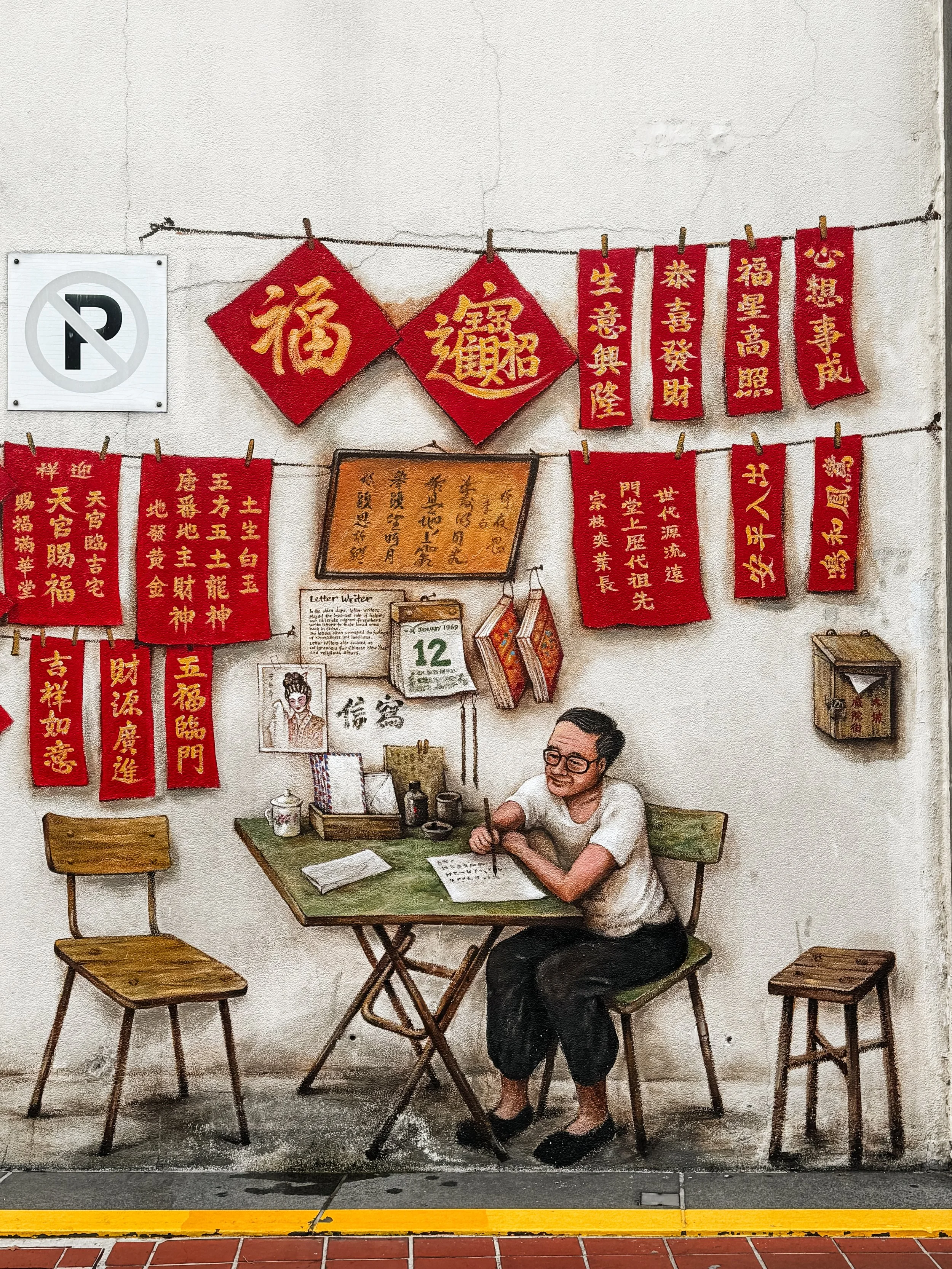
We had booked accommodation in Chinatown, which seemed to be an affordable but central area. It was really lively and vibrant, with lots of markets and restaurants amongst the historic buildings. There were some beautiful street murals throughout alleys and smaller streets of Chinatown, which I loved finding and photographing. 

We chose to stay at the Cube Family Boutique Capsule Hotel on Smith Street. We knew it was going to be a small room but, yeah, we were surprised at just how small the room was. It was designed for families and had a double sized bunk beds, and a single sized bunk bed. The bunks were built like small little capsule / cubby houses and there was also a small bathroom in the room and a well designed cupboard space but all up we estimated that the room was about 12 square meters in total! The kids had a great time though. Hallie had the top double bunk while Braino and I were in the lower one. Farley and Hallie had the single bunks and they were honestly like little cubby holes. Did I also mention there wasn’t any windows! This actually worked out in our favour as the darkness meant the girls slept well, although Braino found that the noise from other guests in the corridor kept him up. Not surprising as the bed was right next to the door, he was able to open the door and stick his head out while still laying in bed. 

Overall, it was an experience, we managed ok, considered we only really slept there; we were out all day on both days we were in Singapore. Would I recommend it to another family of 5? Well it depends on how much patience you can muster when confined to a small space with your family and how much you value privacy and only maybe if you’re relatively small. Haha! So no, I wouldn’t recommend it Haha! 

ACCOMMODATION - The Places We Stayed in Japan

We booked all of our accommodation via booking.com and all the stays were primarily self catered holiday rental style accommodation with the exception of a few hotels. 

We were very happy with booking.com overall and the main reason we choose it in the first place was that it generally provides good cancellation policies and allows you to pay a few days out from your arrival. Airbnb on the other hand takes payment right away and holds it until you check out. We appreciated having some flexibility in our accommodation bookings and keeping as much money in our bank accounts for as long as possible. 

I’ve included links to the accommodation on booking.com. At the moment, these are not affiliate links but I’m working towards setting up affiliate links in the future

TOKYO

The Centurian Classic Hotel Akasaka. 6/10

This hotel is in a fantastic location, Akasaka felt like a quieter neighbourhood although it had plenty of restaurants and bars in the streets surrounding the hotel. 

We were able to walk to Akasaka train station and Akasaka-Mitsuke train station and from there we were able to reach many of the main destinations around Tokyo. 

The hotel staff were great, very friendly and they were especially helpful with our luggage forwarding request. However the room was very small. It had two queen sized beds pushed together which myself and all the girls slept on ( essentially one giant bed ) while Braino slept on a foldout couch. The bathroom was a good size but there was only a hotel style kitchenette and a couch with a coffee table. We managed for 4 nights but it got little cramped. 

No amenities like breakfast or room service but it did have a washing machine in the room.


LAKE KAWAGUCHIKO

Fujiyasan - 11/10

Fujiyasan is a stand alone 2 bedroom house which we were super impressed by.

The downstairs two bedrooms have a queen size bed in each and then there is a third tatami room upstairs where you can set up 2 x Japanese style futons. ( floor mattresses ) 

The kitchen is well equipped and there is a large dinning table and a living area with a couch and TV. 

There is even unexpected things like a hair straightener and projectors in the bedroom. 

The location is the best part - it’s a short walk from the main train and bus station and we could also walk down to the lake. 

There is a stunning view of Mt Fuji when it wasn’t behind the clouds and there was even a bit of outdoor space for the kids to run around in.  This was our favourite accommodation of all, we highly recommend it for Lake Kawaguchiko.

KYOTO

Guesthouse Chayama - 9/10

This was also a two bedroom, two level townhouse that was very much an example of an authentic Japanese house. 

The host, Fiona, made this stay exception. She was originally from England but had been living in Kyoto for many years with her family, including her two teenage girls. 

She didn’t live onsite but she came over on two different occasions to help. She gave us lots of recommendations and info and really helped us out with luggage forwarding. And there were bikes that were free to use, so Braino often road around to collect takeaway for dinner, there we many options within riding distance.

This apartment had two bedrooms upstairs that were only separated by a screen door and that had tatami mats and futons ( floor mattresses ). This was fine for us as a family although Braino wasn’t a huge fan of the futons. But a family with older kids or a group of friends may have found the set up not very practical in terms of privacy. There was also steep stairs between the two levels, so I’d be a little wary with babies and toddlers.

The location was good, as we were a 2 minute walk from a station station, however it was one of the smaller, outer train lines and we had to change after two stops to get to the main train line. This particular train line - the Eizan Main Line, was a little more expensive than the other train lines in Kyoto too.

KOYASAN

Koyasan Guesthouse Tommy 7/10

This is a small hotel / guesthouse run by a friendly man called Tommy, who also had a cafe next door. There are 8 rooms in total and we had two seperate rooms, Farley and Me in were in one with two twin single beds and Braino, Rooney and Hallie in the other room which had a double bed and a fold out couch bed. The beds were western style beds and the rooms were clean and tidy. The main style of accommodation in Koyasan is the Buddhist temple homestays which are very expensive, so Guesthouse Tommy was fine as a budget option. It was in a great location, one street back from the main that runs through the town, and we could walk to everything including the bus stop for the bus that runs to the train station.

OSAKA

Guest House Laule'a Tennoji - 8/10

This was a last minute, budget booking for us which was quite satisfactory . It is a guesthouse / hotel that felt more like a very quiet hostel. The downstairs had a communal kitchen and large living space but there wasn’t any staff or reception. We didn’t see anyone else in there either, even though there was about 4 different floors of rooms. The room we booked had 4 western style beds ( 3 singles and a double ) and even with all the beds it was still very spacious, including a couch, table, kitchenette and large bathroom.

It was a 100m from a train station too so it was a great option for the one night we needed in Osaka to break up the trip from Koyasan to Takayama. 

TAKAYAMA

Taisho Aburaya - 10/10

This is our second favourite acommodation and only because it didn’t have a view of Mt Fuji, ha ha!

The house itself is stunning. It is a large two bedroom stand-alone house, the upstairs was two bedroom only separated by a screen door ( like the Kyoto ) but one had Japanese futons while the second room had two western style double beds. The futons were fine for the girls as it is kind of like having a big sleep over. And the double beds were comfortable for Braino and I as well. 

This house is very authentic in it’s decor while being very well maintained. The bathroom was very modern so maybe it was a newer built house that was done in a very authentic Japanese style. 

The location was great too, we were able to walk to the train/ bus station and we could walk into the main area of the town. We didn’t hear anything from the owners while we were there, it was very much like an Airbnb type stay but that was fine as we didn’t need anything. 


KAMAKURA

Kamakura Sun and Breeze - 6/10


This is another two bedroom house that we booked via booking.com but out of all the accommodation we stayed at, this one was a little disappointing. It felt like someone’s house that they lived in until only recently; there was so much rusted junk around the outside and in the car port while inside there was a lot of cleaning products, although it didn’t really feel all that clean. The bedroom set up as also a little weird, essentially there are 3 rooms (2 tatami rooms and what you would assume is the lounge room) , however, they had put two single beds in the lounge room and zero beds in the other tatami bedroom, there wasn’t even a couch in the whole house - very strange. 

We did have beach views from the kitchen window and there was a large rooftop balcony that we could access. The location was great. It is very close to the beach, a playground and a few restaurants but a slightly further walk to the train stations. 

Oh and the washing machine didn’t work… which was probably the biggest annoyance. Braino had to do a solo mission to find a laundromat as we were down to our last cloths but this stage. Overall it was adequate I just wouldn’t necessarily recommend it to anyone. 

NARITA AIRPORT

Hotel Nikko Narita - 8/10

We flew out quite early from Narita Airport and decided to book into a nearby hotel the night before. Hotel Nikko Narita felt like a well run large business hotel - exactly what you’d expect from something close to the airport. We were able to book a hotel room that had three queens beds in it and it still felt spacious. There was a free airport shuttle bus and the staff were really friendly, they were very helpful and accommodating with receiving our luggage early and storing it for a number of days.

The only disappointing thing was the price and quality of the food in the cafe - it was quite overpriced and bland.


A few other things I would note about accommodation in Japan for families.

  • Bed sharing ( parents and kids ) seems to be quite the norm in Japan so if you’re willing to be flexible about who sleeps where, it will allow for a lot more budget friendly options. 

  • The same goes for being willing to sleep on the traditional Japanese futons ( floor mattresses ). This will give you more options but it’s obviously not ideal for people with back issues or mobility issues. 

  • We didn’t have breakfast included in any of our stays. This would be an option if you were staying at a big brand name hotel but we found it very easy to buy yogurt, fruit, croissants, cereal and milk and juice from the 7-Eleven or Family Marts. There was always one close by.